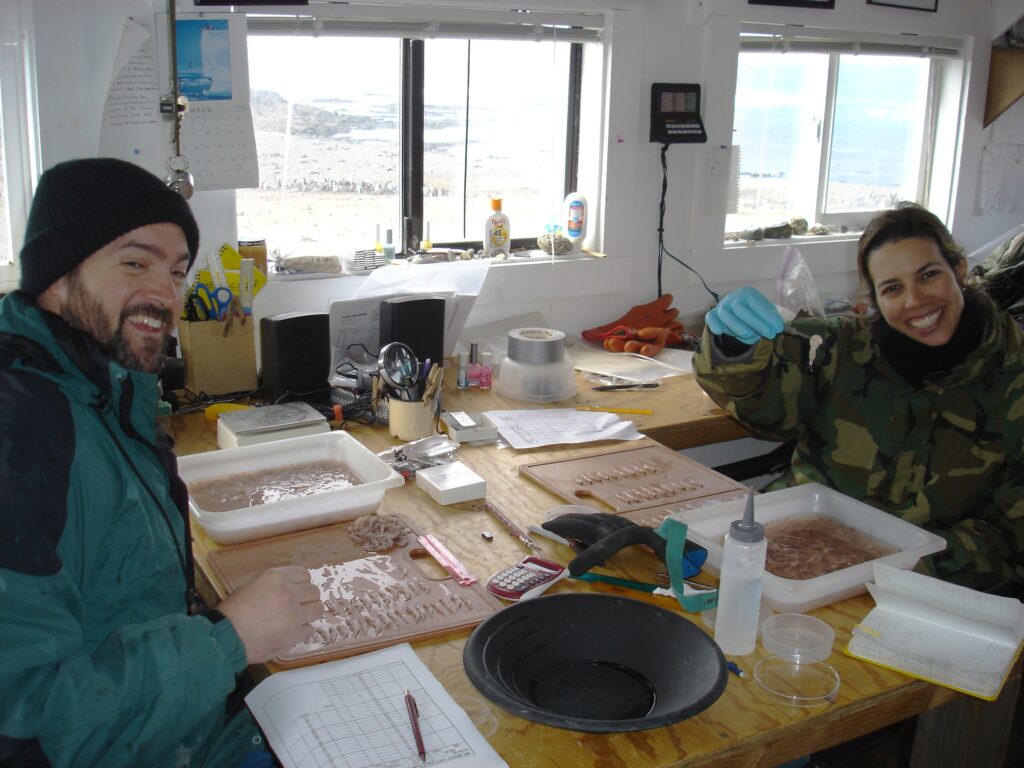
Collaborative research is a key tenet of the LMRCSC II, and few scientists exemplify that better than Carolina Bonin Lewallen, Ph.D., Associate Professor in the Marine and Environmental Sciences Department at Hampton University, and Douglas Krause, Ph.D., leader of the U.S. Antarctic Marine Living Resources Program at NOAA Fisheries.
The two scientists have been actively collaborating, thanks to LMRCSC and National Science Foundation funding, since 2019. They have known each other for nearly 20 years. Lewallen said they both worked for the NOAA Southwest Fisheries Science Center early in their careers, and they both earned their doctoral degrees at the Scripps Institution of Oceanography in 2007-08.
“Our paths converged about six years ago when Dr. Krause took a leadership role at the U.S. Antarctic Marine Living Resource Program, and I also obtained my first significant grants at Hampton University to study Antarctic pinnipeds,” she said.
Lewallen and Krause are currently collaborating on three main projects.
In researching the Northern Antarctic peninsula Weddell seal population, their work involves using molecular markers to understand the role of this population in a broader Antarctic context, Lewallen said. LMRCSC Master’s fellow and recent graduate Ian Santos led the project on Weddell seal population structure, and he continues to work with his former mentors on a manuscript of the research.
Lewallen and Krause are also investigating leopard seal population genomics.
“We are using genomic-level markers to uncover historical demography and population structure of this iconic Antarctic predator. We were able to obtain the first genetic estimation of effective population size for leopard seals. This published work, led by former LMRCSC fellow Arona Bender, is being used in the current [International Union for Conservation of Nature] re-assessment of the leopard seal status,” Lewallen said.
“Our group also recently published a high-quality leopard seal genome assembly and used it as a refence to estimate the site fidelity of leopard seals at Cape Shirreff, a NOAA research site in the Antarctic peninsula, for nearly a decade. This work revealed that some seals have been returning to this site for at least eight seasons and one had offspring and a distant relative in our dataset. This is a significant finding for a solitary predator, and it was recently published in Scientific Reports.”
Lastly, Lewallen and Krause are looking at comparative genomics and epigenomics of Antarctic pinnipeds. For this project, the scientists compare the genomes of leopard and Weddell seals to investigate their evolutionary history and unique adaptations.
“This collaboration is invaluable for my career [because of] the expertise of Dr. Krause in Antarctic pinniped ecology and, of course, the samples and associated metadata that make all the genetics and genomics work possible,” Lewallen said.
Lewallen became an LMRCSC Faculty member when she started at Hampton University in 2017. She said the Center provided her with funding, received from the NOAA Educational Partnership Program (EPP), for her first students and her lab supplies.
“It also gave me a clear path for me to reignite long-standing NOAA partnerships. I was able to build on this initial opportunity, and I also found new collaborators and like-minded researchers through the LMRCSC network, including Dr. Tara Cox at [Savannah State University],” she said.
For content suggestions or questions about LMRCSC news, please contact Kara Nuzback, kanuzback@umes.edu.
