
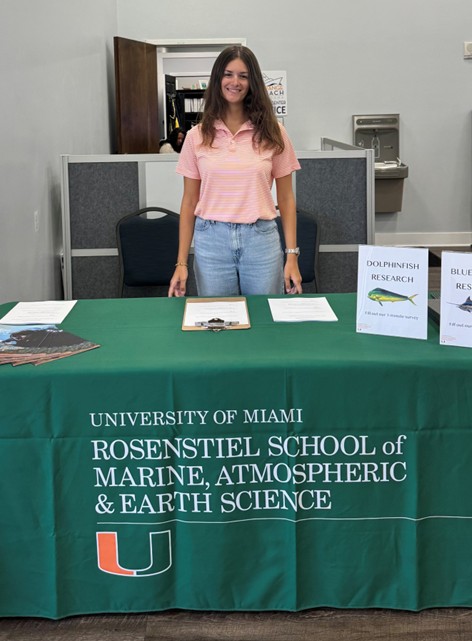
Stock assessment is crucial to ensuring a healthy supply of domestic seafood and keeping coastal economies thriving. An LMRCSC II fellow examining dolphinfish populations recently received a funding boost to further her research.
The Scott B. Gudes Public Service Graduate Scholarship is awarded to master’s or doctoral students pursuing NOAA Fisheries related disciplines whose research has a strong potential to contribute to the advancement of marine resource conservation. Candidates must also display evidence of exemplary public service.
Michelle Fernandez is a doctoral student whose goal is to better understand the state of certain fish populations and identify management strategies to improve their stock. Fernandez, who is majoring in Marine Biology and Ecology at the University of Miami Rosenstiel School of Marine, Atmospheric, and Earth Science, was awarded $2,000 through the Gudes scholarship for the 2024-25 academic year.
The title of her dissertation is Evaluating environmental and fishing stressors on the population dynamics of dolphinfish (Coryphaena hippurus) in the Inter-American Seas. Her work integrates governmental, environmental, and, thanks to Gudes funding, social perspectives to evaluate the status of dolphinfish fisheries in the Gulf, the Southeastern U.S., and the Caribbean Sea.
“I was able to attend the Blue Marlin Grand Championship in Orange Beach, Alabama, this past summer and complete 27 surveys asking fishers for their perceptions on dolphinfish landings decline, changes in size distribution, and catch per unit effort over the course of their fishing career,” Fernandez said. She plans to compare these testimonies of perceived changes with quantitative data she has collected throughout the course of her research.
“I believe that utilizing the qualitative information of fishers’ historical knowledge along with quantitative data analyses allows for a more holistic approach to management, and the Gudes Scholarship has greatly aided me in furthering this goal,” she said.
She plans to attend another fishing tournament and conduct more surveys this spring.
Fernandez’s quantitative data includes comparisons of catch compositions among several countries and gear types. Using this, she will identify where dolphinfish represent a larger share of the total number of fish brought to shore, highlighting geographic differences in targeting behavior among fleets.
Through her participation in an International Commission for the Conservation of Atlantic Tunas (ICCAT) project, she can collect catch and effort data from small-scale and artisanal fisheries in various Caribbean, Central and South American countries.
