For 15 years, University of Maryland Eastern Shore Professor and NOAA LMRCSC Faculty Member Dr. Salina Parveen and NOAA Cooperative Oxford Lab Director Dr. John Jacobs have worked together to ensure Maryland shellfish are safe to eat. About five years ago, NOAA Fisheries Office of Science and Technology Acting Deputy Director Howard Townsend joined the collaboration. Together, their work examines pathogens, including Vibrio and Shewanella bacteria in coastal waters and seafood, particularly in the Maryland region.
“Their expertise and resources have been instrumental in helping us achieve the goals of our project, including training graduate students, publishing peer-reviewed journal articles, and securing external funding,” Parveen said. “LMRCSC is an excellent platform for connecting with NOAA scientists, especially through NETRO internships for LMRCSC fellows.”
In the course of their research, Parveen, Jacobs and Townsend have uncovered critical insights into how environmental dynamics influence pathogen risks in shellfish. Their work proved the presence of Vibrio parahaemolyticus, Vibrio vulnificus, and Shewanella in oysters is not random; it varies predictably with water temperature, salinity and seasonal cycles. Warmer conditions generally promote bacteria. They observed similar trends for Vibrio species in blue crabs, indicating that these environmental drivers affect multiple seafood species.
Parveen, Jacobs and NOAA LMRCSC Alum Dr. Tahirah Johnson also examined ecological interactions involving the comb jellyfish (Mnemiopsis leidyi) and found associations with the abundance of pathogenic Vibrio species and harmful algal communities in the Maryland Coastal Bays.
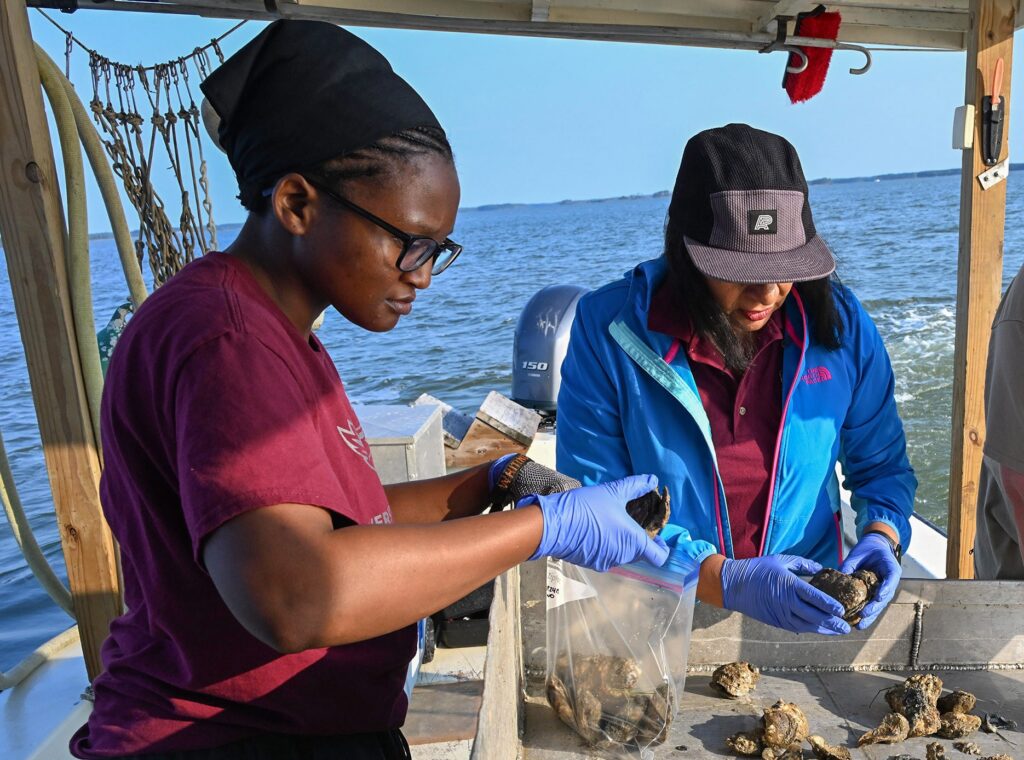
Students in Parveen’s lab conduct lab and field research, and learn to analyze microbial data.
“Through this collaboration, four doctoral students and three M.S. students have successfully completed their degrees. Currently, one Ph.D. student is focused on understanding the population dynamics of Vibrio species in oysters and surrounding waters in the Chesapeake Bay,” Parveen said.
Several students, including Johnson and LMRCSC alum Dr. Jasmine Smalls have co-authored papers with Parveen, Jacobs and Townsend. Parveen has published seven peer-reviewed journal articles with Jacobs and twopeer-reviewed journal articles with Townsend.
Their research established that pathogen levels vary significantly by location and season, highlighting the importance of region-specific management strategies. The team’s findings provide a framework linking environmental conditions to microbial ecology and human health risk. This supports the development of predictive models, improved harvesting guidelines, and seafood safety regulations aimed at reducing foodborne illness.
