Dr. Lila B. Karki and Dipendra Gurung
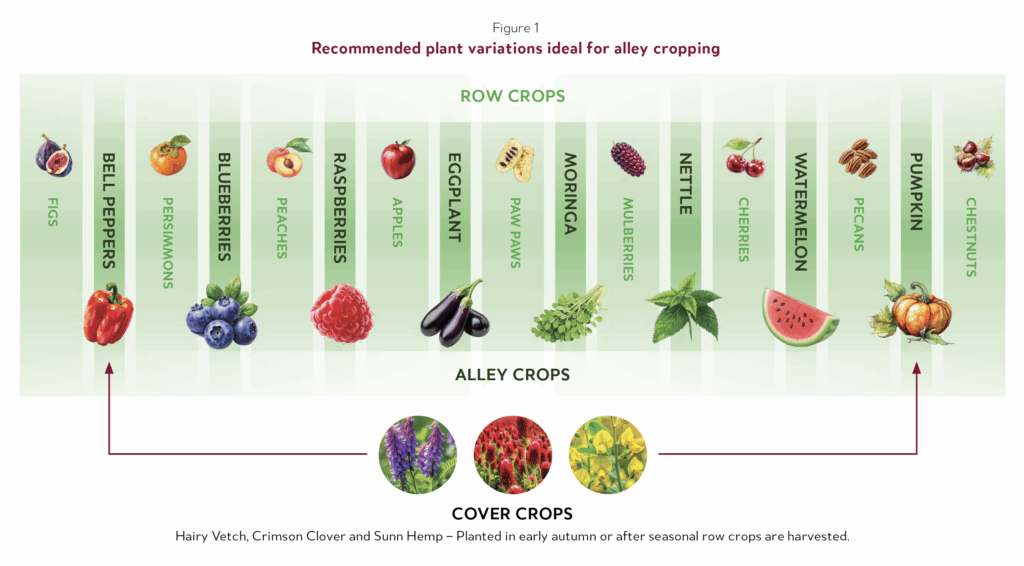
An alley cropping system is an agroforestry practice in which trees or shrubs, often bearing fruit or berries, are planted in rows with vegetables or medicinal herbs planted in the alleys in between. This system can provide long-term benefits like farm income through companion crop production, and soil and ecosystem improvements.
What technology and agricultural practices can help?
Practices and technologies used in alley cropping include:
- Crop variety and placement
- Organic farming
- Cover cropping
- No-till/minimum tillage
- Soil and water management
- Mulching
- Integrated pest management
- Weather-based crop advisory services
Economic benefits
Some potential economic benefits of alley cropping include::
- Land efficiency and value
- Varied income streams
- Reduced economic risks
- Lower production costs
- Enhanced crop pollination and yield
Ecosystem benefits
Potential ecosystem benefits are wide ranging, such as reduced erosion, soil disturbances and wind damage to crops. Improved soil fertility through natural decomposition of organic matter, beneficial insects and pollinator attraction. Soil moisture increase and reduced heat stress are also helpful. Unproductive land can be restored. Alley cropping systems have the potential to help withstand natural disasters from heatwaves, droughts, floods and severe storms.
Challenges of implementing alley cropping system
It is a complex system requiring a broad agricultural knowledge base, along with physical management and skills. The balance of tree versus crop shifts over time as light, water and nutrients change, requiring adaptations. Initial capital investments can be substantial to establish fruit trees and shrubs. Alley cropping is a commitment that is best for long-term land tenure.
How UMES Extension can help
UMES Extension’s Community and Economic Development Program hosts training workshops and meets with individual farmers to teach about alley cropping systems.
More information
Contact Lila B. Karki, University of Maryland Eastern Shore (UMES) Extension program evaluation specialist and associate professor of agriculture economics, at lkarki@umes.edu or 410-651-6693.
Visit UMES Extension website
Dipendra Gurung is a graduate student at UMES.
This work is supported by project award no. NR243A750004G014, subaward 303124423776190 from the U.S. Department of Agriculture’s Natural Resources Conservation Service and 2024-38821-42089 from USDA’s National Institute of Food and Agriculture.