
By S. Onley, D. Grady, S. Kirongo, K. Braxton and E.N. Escobar
Abstract
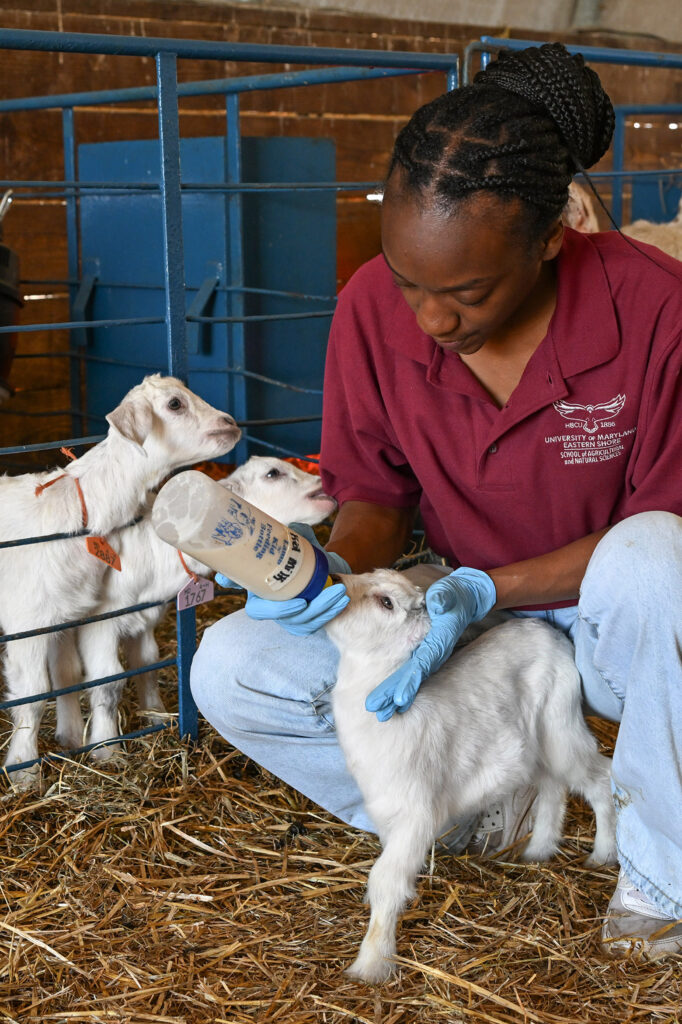
The objective of this report is to describe the training of upper-class animal science intern students in critical thinking, data organization, and technical writing.
The present report is a systematic data collection in which animal science students examined in-depth data related to goat kid performance from birth to weaning, number of offspring, and mortality rate, using Average Daily Gain (ADG) as the performance expression.
The data was collected during kidding seasons 2022 and 2023 at the UMES Small Ruminant Farm, Princess Anne, MD – (38.21595° N, 75.67918° W).
Goats, Capra hircus, are bred, raised and studied at the university. For example, in 2023, data was collected from a kid crop of N=34 kids, with a mortality rate of 12% resulting in an analyzable sample of n=30. The number of offspring per litter is also being a significant factor since does can carry up to 4 kids at a time, thus, affecting performance. For the 2023 kidding season, and at age 40 d after birth, twin kids’ ADG was 196.8 g, triplets’ ADG was 167.6 g, and quads’ ADG was 154.1 g. Each year intern students have the hands-on opportunity to be part of the seasonal breeding that takes place beginning in November and ending in late April of the following year. Such experience enrich their knowledge and sharpen their skills enhancing their future professional lives.
Introduction and Objectives
The objective of this study was to give intern undergraduate students working at the UMES Small Ruminant Farm the opportunity to develop critical thinking, data organization and technical writing skills through the observation and data recording of the performance of goat kids (Capra hircus) that were born and raised on the farm.
Materials and Methods
Kiko and Spanish are the two prevalent goat breeds at the UMES Small Ruminant Farm and synchronized breeding is practiced using EAZI-BREED™ CIDRs® (Zoetis, Inc; Kalamazoo, MI, USA) to promote scheduled kidding and a uniform kid crop (age, nutritional requirements, etc.). In 2022 and 2023, does were exposed to bucks after CIDR’s were removed, does were identified as pregnant following a blood sample (>35 d after breeding) analyzed by BioPRYN® (Bio Tracking, Inc, Moscow, ID). BioPRYN® measures the presence of Pregnancy Specific Protein B, a protein only produced by the placenta of a growing fetus(es) (Anonymous).
At birth, kids were checked for vital signs, temporally tagged for identification and the following data was recorded: size of the litter, sex, and body weight (BW). The newborn kids were weighed using a large bucket and fishing scale.
Also, iodine (7% tincture) was applied to the umbilical cord/navel area and suckling of colostrum was verified. In few instances, nursing was encouraged to distressed or small kids. Subsequent BW measurements were done using a commercial livestock scale. Rubber band castration and CD/T vaccination occurred at 6 weeks.
In 2022, kids were weaned at 93 d. The data was entered into an Excel (Microsoft Office Suite) spreadsheet and calculations for average birth BW, ABG at different ages and by sex were performed using the available formulas in Excel. The data was not statistically analyzed because of the sample size and the intention of the exercise was on data collection and organization only.
Table 1: Distribution of the 2022 goat kid crop by sex and litter size

Results and Discussion
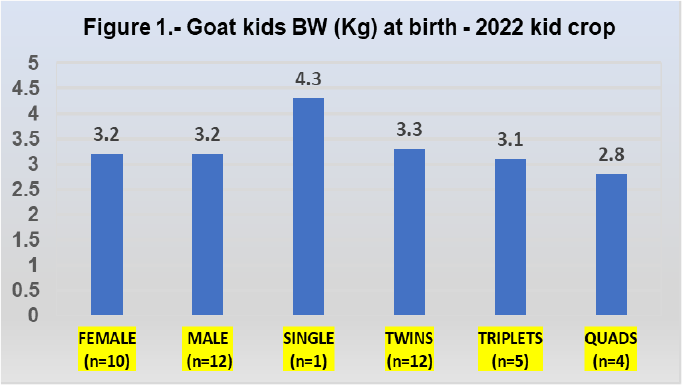
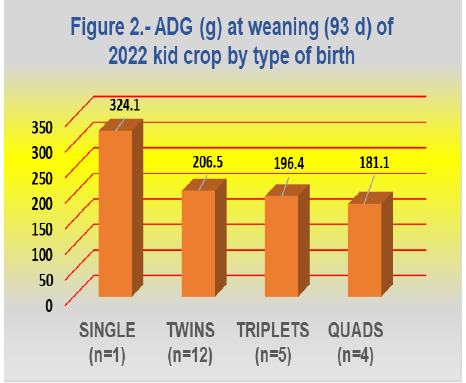
During the 2022 kidding season, data from 22 kids was collected and used for this report. Table 1, shows the distribution of the 2022 goat kid crop by sex and by type of birth (litter size). Overall ADG for all the kids (N=22) was 205.2 g/d.
As expected, the single kid had the highest ADG (324 g/d) as compared with twins, triplets, and quads (206.5, 196.4, and 181.1 g/d, respectively). Growing doelings performed slightly better than males as expressed by ADG (207 vs 203 g/d, respectively). Figure 2, shows the ADG (g/d) of weaned kids (93 d) by type of birth. In 2023, at age 40 d the kids’ overall ADG (N=30) was 179 g. Data from one kid was not collected at 300 d, then N=29.
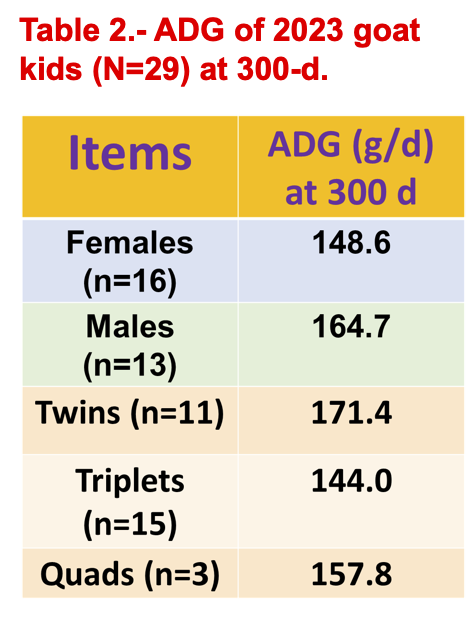
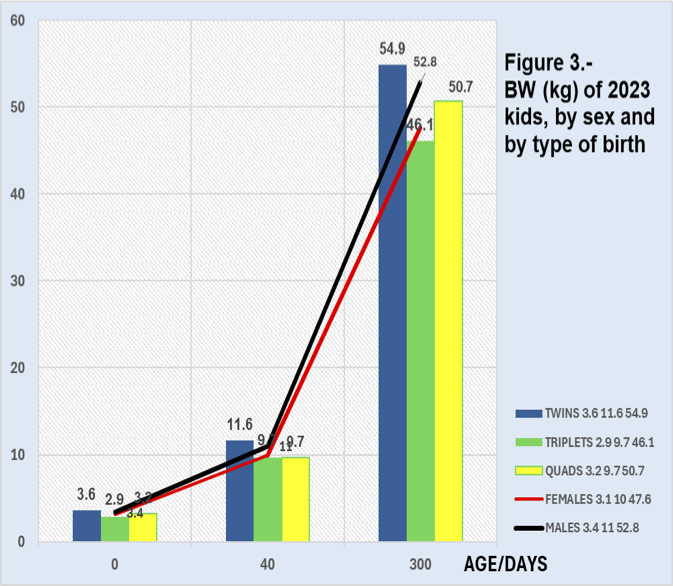
In 2023, kid mortality rate was around 3%. Male kids were heavier at birth, than female kids (3.1 vs 3.4 kg, respectively) and male kids ADG also was higher than female kids (Table 2). Overall, twin kids performed better than triplets and quads from birth to the 40-d and 300-d marks (Figure 3).
Synchronized breeding allowed enhanced kid survival because there is an abundance of preparation and planning at kidding, i.e., labor, feed, and milk replacer, if needed.
Conclusions
Being a part of this study has been very beneficial. From students to student interns the knowledge of farm management was able to be applied to daily tasks at the UMES Small Ruminant Farm.
It is essential to know how each specific farm operates. While in the classroom, interns were taught the reproductive and food animal aspects; on the farm interns were guided on critical thinking and technical writing through conducted lab sessions.
While working with the Kiko and Spanish crosses, students were able to practice certain protocols on our research farm. Examples of these protocols would be synchronized breeding, rotational grazing, ear tagging, hoof maintenance, weighing, data entry, and more.
With these skills of managing a small ruminant farm I plan to continue to enhance my knowledge of large animal veterinary medicine by applying to a DVM program in the near future while continuing to practice such skills throughout my remaining time here at UMES.
This program has given students the opportunity to see into the food animal world as well as the large animal veterinarian world, thus giving them an advantage compared to other future DVM students.
References
Anonymous. (n.d.) What is BioPRYN® ? https://heardhealthdiagnostics.com/about. Accessed January 2024.
Acknowledgements
- This work was supported in part by the intramural research program of the United States Department of Agriculture, National Institute of Food and Agriculture, Agricultural Extension Programs at 1890 Institutions — grant NI221444XXXXG016 in partnership with the State of Maryland Legislature.
- Also, a grant from the Center for Farming Systems, Rural Prosperity and Economic Sustainability —1890 Universities Foundation.
This study was presented at the ARD Research Symposium hosted by the Association of 1890 Research Directors from April 6-9 in Nashville, Tennessee.
