
By E.N. Escobar, J.J. Rodriguez and H. Taylor
This report was presented at the 5th Grazing Livestock Nutrition Conference: Enhancing management, production, and sustainability of grazing ruminants in extensive landscapes, held July 17-19, 2016 at Canyons Resort, Park City, Utah
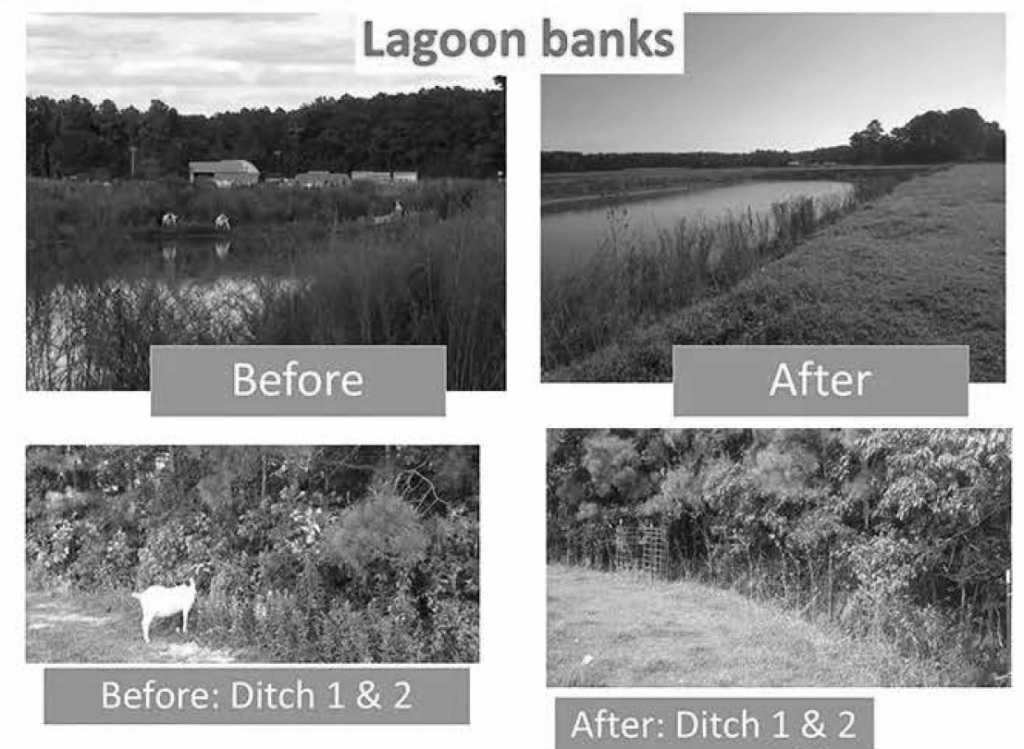
Targeted grazing has been practiced for thousands of years and along with fire, grazing is the oldest vegetation management tool (Launchbaugh and Walker, 2006). The benefits from the utilization of grazing have beenstudied at length in silvopastural systems, some of the benefits of grazing versus the use of machinery and chemicals are increased soil fertility and preservation (Power, 2003), biodiversity conservation (Pagiola, 2004), atmospheric carbon sequestration (Soto-Pinto, 2010) and mitigation of greenhouse effect gasses (Schoeneberger, 2009).
Farmers utilizing targeted grazing in similar systems also observe benefits such as increased quality in forage and animal production (Yamamoto, 2007; Paciullo, 2011).
Objectives
- The main objective was the development of a module with multiple components to propose solutions for management of unwanted vegetation using sheep and/or goats on Delmarva.
- Educate and train farmers, extension educators, foresters, master gardeners, faculty and administrators in how to use sheep and goats to manage unwanted vegetation.
- Promote the sustainability of sheep and goat farms by utilizing unwanted vegetation
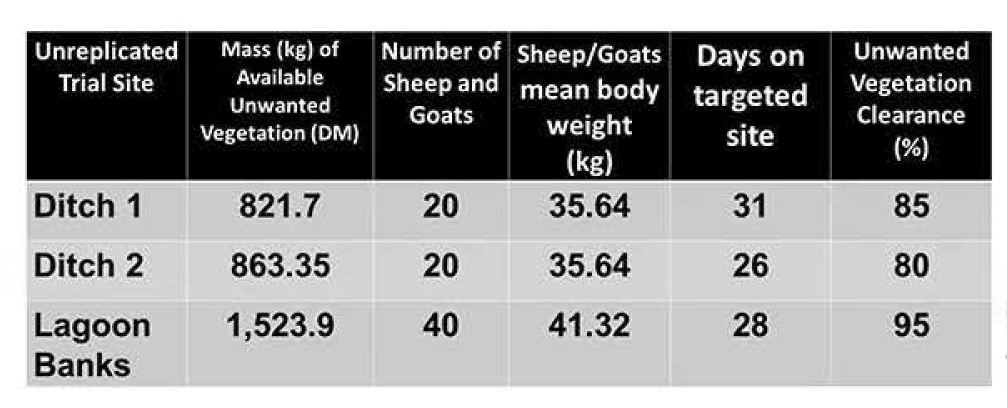
Parameters considered when using sheep and goats to manage unwanted vegetation at two trial sites in Princess Anne, MD
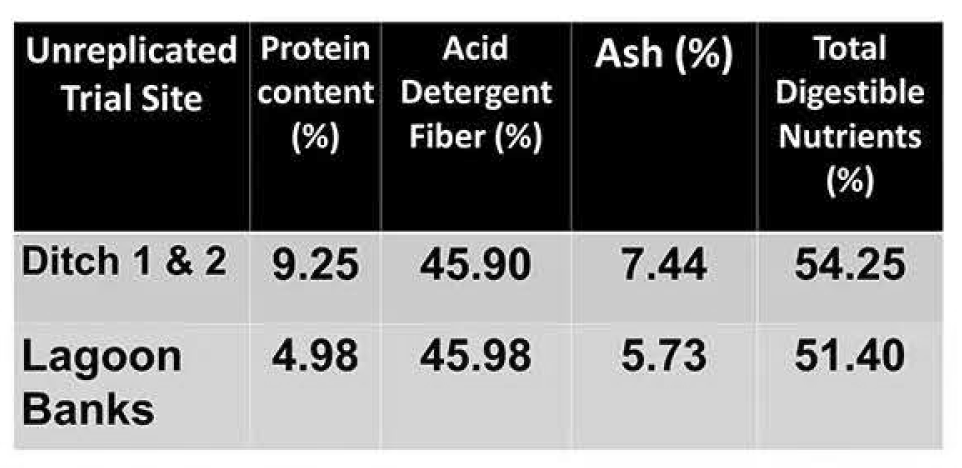
Nutritional value of unwanted vegetation at two trial sites in Princess Anne, MD
Methodology
Two groups of animals were selected.
- Group A had 10 ewes and 10 does. The target area consisted of two drain ditches: Ditch #1 with a woody patch on both sides of the ditch containing mixed understory species (total area of 1,149.77 m2). Ditch #2 also contained mixed understory, predominantly multiflora rose (Rosa multiflora) and had a total area of 1,010.47 m2. Sheep and goats were allowed in the targeted areas from 8 a.m. to 4:30 p.m. daily except when raining.
- Group B consisted of 40 sheep and goat weathers. The target area consisted of steep lagoon banks in two lagoons with a combined target area of 1,525.24 m2• The vegetation was predominantly horseweed (Coniza canadensis (L.)).
In both targeted sites, prior to exposing the target sites to the animals, several random locations (1 m2) were selected and all vegetation inside the squared meter was clipped, collected, weighed, air dried, and analyzed (proximate analysis).
Plant samples were also collected and pressed in newspaper for future identification.
There was no diet supplementation for any of the groups and access to water and mineral salt was available constantly.
General set-up process:
1. Select grazing animals
2. Select the target grazing site
3. Sample collections
4. Determine enclosure strategy (fencing)
5. Apply the grazing pressure: animal units and time on the target plots
Results
- The sheep and goats readily engaged in consuming the target site’s vegetation
- Adapted to the daily management.
- Group A remained on target site for approximately 31 days and cleared 85% of the unwanted vegetation. Group B remained on target site approximately 28 days and cleared 95% of the unwanted vegetation.
Conclusion
The utilization of sheep and goats to control unwanted vegetation in forest, public and sensitive areas is a viable alternative that could potentially reduce costs associated with the use of chemicals or machinery. In addition, the use of sheep and goats could help reduce environmental pollution produced by the overapplication of herbicides.
Small family farms can take advantage either by adding goat meat production to their existing practices or by potentially lowering their production costs in situations where the animals can replace chemicals or machinery by developing a vegetation management business using sheep and goats.
References
- Launchbaugh, Karen, and J. W. Walker. 2006. “Targeted grazing — a new paradigm for livestock management.” Targetted grazing: A natural approach to vegetation management and landscape enhancement. Centennial, CO, USA: American Sheep Industry Association: 2-8
- Power, I.L., B. S. Thorrold, and M. R. Balks. 2003. “Soil properties and nitrogen availability in silvopastoral plantings of Acacia melanoxylon in North Island, New Zealand.” Agroforestry systems 57.3:225-237.
- Paglola, Stefano. 2004. Paying for biodiversity conservation services in agricultural landscapes.
- Soto-Pinto, Lorena. 2010, Carbon sequestration through agroforestry in indigenous communities in Chiapas, Mexico. Agroforestry Systems 78.1: 39-51.
- Schoeneberger, Michele M., 2009. Agrofestory: working trees for sequestering carbon on agricultural lands. Agroforestry Systems 75.1: 27-37.
- Yamamoto, Wataru, loan Ap Dewi, and Muhammad lbrahim, 2007, Effects of silvopastoral areas on milk production at dual-purpose cattle farms at the semi-humid old agricultural frontier in central Nicaragua. Agricultural Systems 94.2: 368-375.

These projects are sponsored by a USDA/NIFA Capacity Building Grant (MDX-ESCOBAR) and Evans-Allen grant.
