
By O.L. Ludolph*, K. Tyree-Castro, S. Kirongo, K. Braxton, P. Natarajan, and E.N. Escobar
Abstract
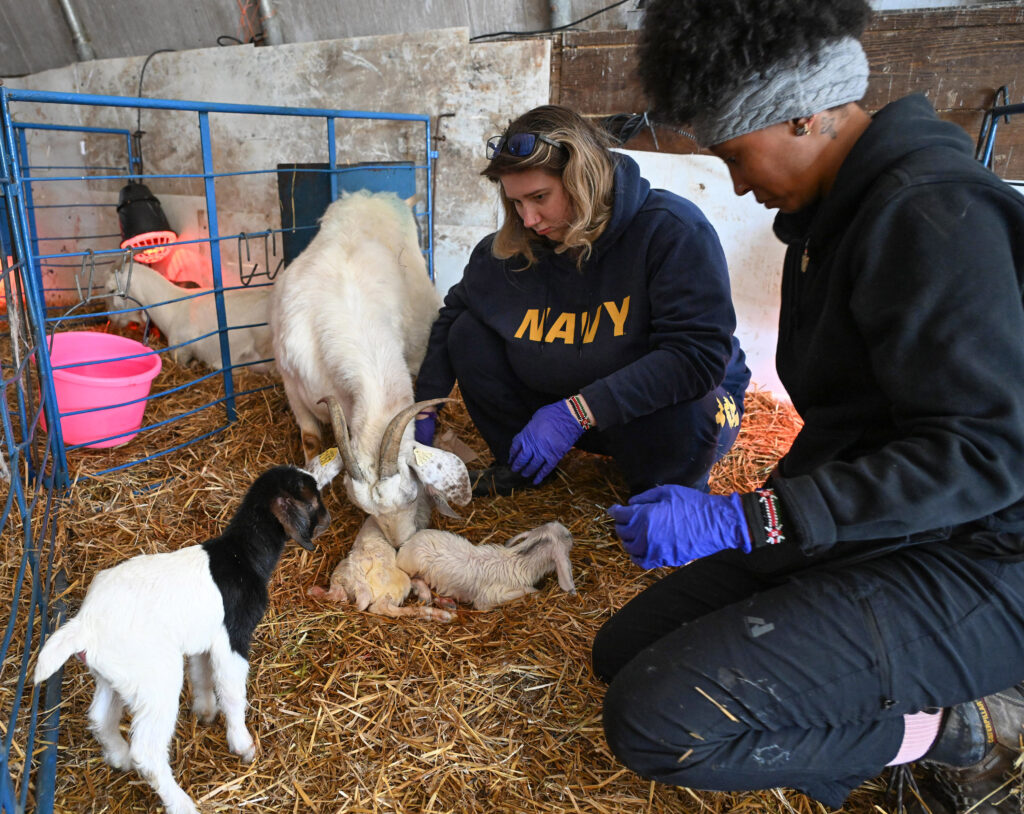
This report outlines the training of upper-class Animal Science interns in critical thinking, data analysis, and technical writing through a study of newborn sheep (Ovis aries) performance at the University of Maryland Eastern Shore (UMES) Small Ruminant Farm in Princess Anne, MD, 21853 – (38.21595 ° N, 75.67918 ° W).
Data consecutively collected during the 2022 to 2025 lambing seasons (N = 76) were used to examine how sex, type of birth, and age influenced body weight, which was then used to calculate Average Daily Gain (ADG) as the primary performance indicator.
At lambing, type of birth was a significant factor (p <0.0001), since ewes are multiparous and can carry up to four lambs at a time. For example, in 2025, male lambs (n = 16) had a slightly higher ADG than female lambs (n = 18) at 101 days (170.24 + 8.6 g/d vs. 156.1 + 12.05 g/d). Similarly, at 97 days, in 2022, the ADG of twins (n=14, 277.64 + 10.3 g/d), and triplets (236.86 + 13.6 g/d, n = 4).
These results demonstrate how sex and type of birth influence growth performance in lambs. Through participation in breeding, lambing, data collection and data analysis, interns gained valuable hands-on experience evaluating growth performance. They enhanced their analytical and technical writing skills for their future careers in animal science.
Introduction & Objectives
Small ruminants are an excellent and affordable model for aspiring animal scientists, veterinarians and other science students to learn about life, science, data collection and data processing.
At the UMES Small Ruminant Farm, a breeding synchronization protocol has been used for the last 10 years to simplify and optimize the lambing season. Such a practice allows for a population of lambs of the same age (+ 7 days) for studying growth, and in this case, determining Average Daily Gain (ADG) as an indicator of performance.
The objective of this study was to give intern undergraduate students working at the UMES Small Ruminant Farm the opportunity to develop skills in critical thinking, data organization, communication and technical writing skills through the observation and data recording of the performance of lambs that were born and raised on the farm during four consecutive lambing events.
Materials & Methods
Katahdin is the prevalent sheep breed at the UMES Small Ruminant Farm, and synchronized breeding is practiced using EAZI-BREEDTM CIDRs® (Zoetis, Inc.; Kalamazoo, MI, USA) to promote scheduled lambing and a uniform lamb crop (i.e., age, nutritional requirements, vaccinations, etc.).
Lambs’ data were collected during four consecutive lambing seasons, 2022 to 2025. At birth, newborns were checked for vital signs, temporarily tagged for individual identification, and the following data were recorded: type of birth (Single, Twin, Triplet), sex, and body weight (BW) – newborn lambs were weighed using a large bucket and a fishing scale.
Also, iodine (7% tincture) was applied to the umbilical cord/navel area, and colostrum was verified as being suckled. In a few instances, nursing was encouraged for distressed or small lambs. Subsequently, a weighing date was used to calculate ADG, 97 d in 2022, 47 d in 2023, 88 d in 2024 and 100 d in 2025.
Statistical Analysis Methods
The effects of lambing year, type of birth, and sex on ADG and birth BW were evaluated using separate one-way analyses of variance (ANOVA). When the overall ANOVA F-test was significant (α = 0.05), pairwise mean comparisons were conducted using Tukey’s honestly significant difference (HSD) test, followed the descending convention, whereby “a” was assigned to the group with the highest estimated marginal mean, consistent with standard publishing practices.
Sex differences in ADG within each lambing season were assessed separately using independent-samples t-tests, and the overall sex effect pooled across all years was similarly evaluated by t-test. The linear association between birth body weight and ADG was quantified using the Pearson product-moment correlation coefficient (r), with a two-tailed test of significance. All results are reported as mean ± standard error (SE), and statistical significance was declared at p < 0.05.
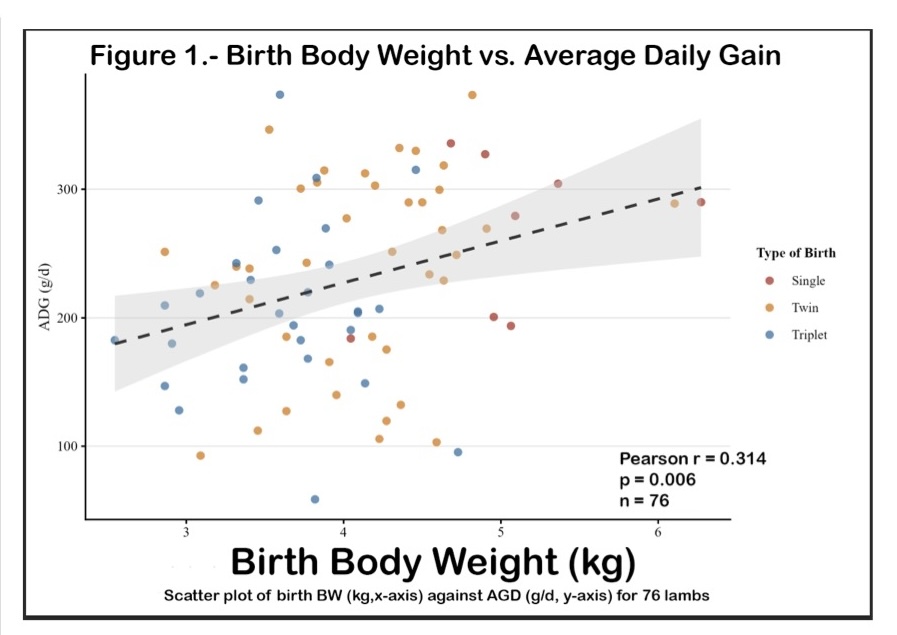
Interestingly, Birth BW was positively associated with ADG across all lambs (Pearson r = 0.314, p = 0.006) as depicted in Figure 1. Heavier lambs at birth tended to grow faster during the pre-weaning period. Thus, lambs with greater BW maintained a growth advantage during early development.
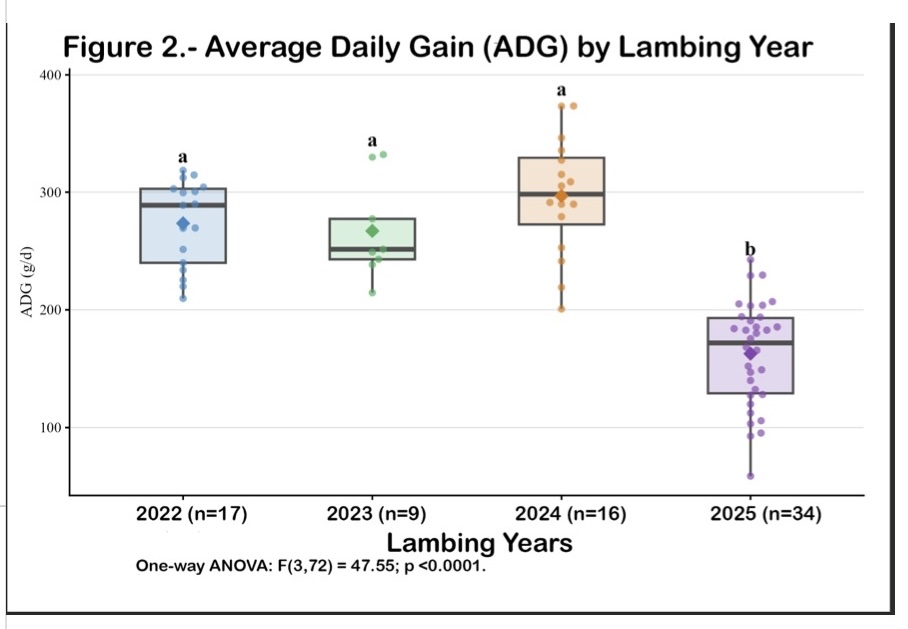
In Figure 2, differences are also evident across lambing years. Definitely, yearly environmental conditions and/or management practices contribute to year-to-year variations affecting lamb growth performance.
Conclusions
Overall, birth type had a strong effect on lamb birth BW, with single-born lambs exhibiting the greatest BW and triplet born lambs the lowest. Birth weight was positively associated with postnatal growth, highlighting its importance as an early predictor of lamb performance. In contrast, sex had minimal influence on growth traits, while lambing season significantly affected ADG, suggesting possible seasonal effects related to environmental or management conditions (Figure 2).
Olivia Ludolph is a December 2025 UMES graduate with a B.S. in General Agriculture, concentrating in Pre-Veterinary and Poultry Science. Since working at the UMES Small Ruminant Farm, Olivia has developed as a professional, by gaining valuable hands-on experience in animal care. She is applying to veterinary medical schools to become a mixed animal veterinarian specializing in surgery.

This work is supported by the U.S. Department of Agriculture’s National Institute of Food and Agriculture. In addition, Agricultural Extension Programs at 1890 Institutions — Grant NI221444XXXXG017, in partnership with the State of Maryland Legislature. Also, a grant from the Center for Farming Systems, Rural Prosperity and Economic Sustainability — 1890 Universities Foundation.
The findings and conclusions in this preliminary presentation have not been formally disseminated by the U.S. Department of Agriculture and should not be construed to represent any agency determination or policy.
