
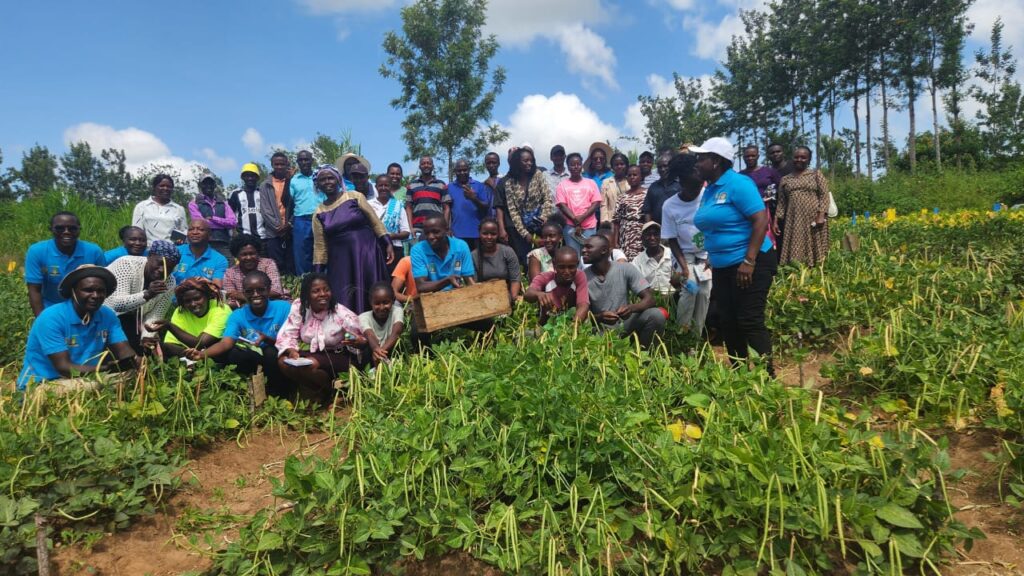
IPM training for farmers was held at an on-farm site in Murang’a County, Kenya.
The project site, Ithanga, Murang’a County, is in the eastern region of Kenya, known for its low midland landscape, and situated in a semiarid agroecological zone. This area experiences prolonged dry spells and significant moisture stress, which affects agricultural productivity and local ecosystems.
The project’s main objective is to enhance agricultural productivity and improve food security in Murang’a County through bridging existing knowledge gaps by integrating scientific findings into conventional farming practices in the region. Partners include Kenyatta University (KU), the University of Arkansas at Pine Bluff, and the Southern University Agricultural Research and Extension Center (SUAREC).
The project targets smallholder farmers, extension personnel from the county government and Kenyatta University researchers, along with students and faculty, who will focus on integrating ecologically responsive technologies and sustainable farming practices, and promoting food security through research, training and stakeholder engagement.
Key to achieving the intended success includes the establishment of Farmer Field Schools (FFS) and on-farm demonstration plots planted with crops such as maize, sorghum, beans, cowpeas and fodder.
This project empowered more than 50 smallholder farmers, three county government personnel, two KU postgraduate students and four undergraduate field assistants by equipping them with skills needed to address critical agricultural challenges in the area, such as pest management, water and soil preservation.
In addition, the project has developed innovative sustainable strategies to improve fodder production involving the mass rearing of Azolla and the scaled production of duckweed as feedstock for chicken and rabbits.
In the project’s first year, key outcomes included developing training materials on integrated pest management (IPM), livestock feed and extreme weather-resistant agriculture. As the project progresses, it is crucial to concentrate more on scaling up successful strategies, empowering farmers, expanding outreach activities and ensuring broader adoption of lessons learned.
Through continuous capacity building, participatory research, and a focus on long-term impact, this initiative will lead to a more resilient and food-secure Murang’a County in Kenya.
