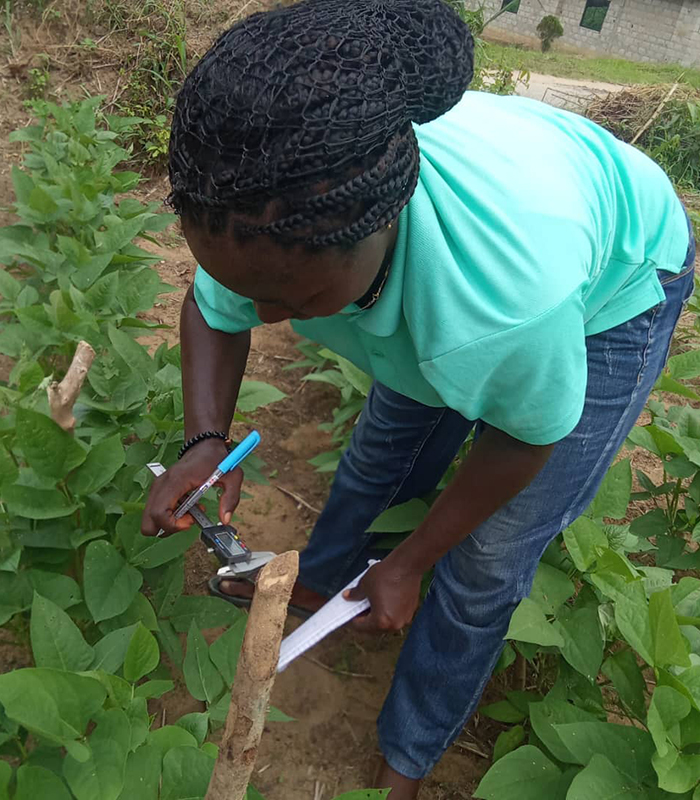
A UNICAL student takes growth parameter data on cowpea.
Food insecurity remains a major challenge in Sub-Saharan Africa, and it’s still the major contributor to protein-energy malnutrition. A gradual stagnation of agricultural productivity in recent years has been a major concern, given the continuous population growth.
Yet, smallholder farmers lack basic agricultural inputs, financial support and extension services. Delaware State University (DSU) and Kentucky State University (KSU) students and scientists, in collaboration with students and scientists at the University of Calabar (UNICAL), Nigeria, established an intercropping farming study to examine crop production and food processing practices.
More specifically, the project objectives were to train a globally competent workforce, advance sustainable agriculture practices, add value to perishable crops, enhance food availability throughout the season, improve nutrition knowledge through nutrition
education and enhance postharvest management strategies to strengthen food security in the region.
The intercropping farming study was conducted at two sites, including the UNICAL Teaching and Research Farm and the Faculty of Agriculture Extension Village in Calabar. The farm provided training and hands-on experiential learning opportunities for students and scientists. While 15 students from various departments (i.e., Agricultural Extension, Agricultural Economics, Fisheries and Aquaculture, Crop Science, and Food Science and Technology) received training, 12 scientists participated in these activities.
Approximately quarter-acre plots of okra/cucumber mixed vegetables and a half acre of cassava/cowpeas mixed crop were planted at the UNICAL and the Extension Village farm, respectively.
While cassava growth and production data were expected in August 2025, cucumbers performed very well in terms of vegetative growth and fruit production per acre compared to previous years. Farmers who participated in the workshops gained insight into intercropping farming practice and were willing to expand cowpea production in the region.
DSU and KSU scientists who traveled to UNICAL in summer 2024 organized two workshops and training sessions focused on capacity building for UNICAL’s scientists, students, extension personnel and farmers.
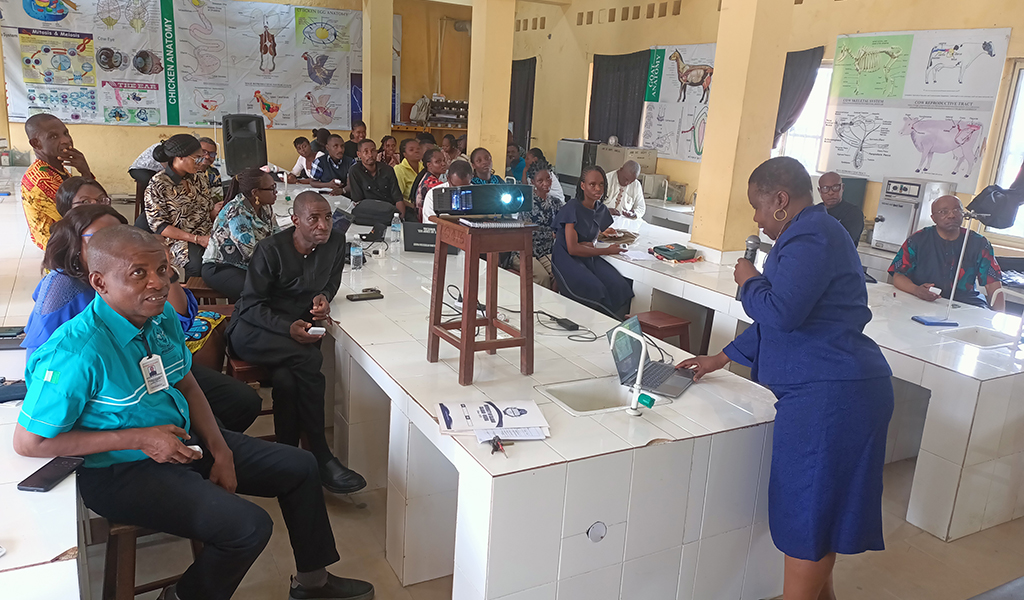
Dr. Rose Ogutu delivers a talk on pre- and postharvest factors in food production at UNICAL.
During the workshops, Drs. Rose Ogutu and Theoneste Nzaramyimana provided training sessions on best agricultural practices and low-cost food preservation techniques to prevent pre- and postharvest losses and enhance food availability.
They also provided training on organic composting and delivering extension services to the clientele — the USA land-grant model.
In addition, Drs. Samuel Besong and Frederick Bebe held a nutrition education seminar on various topics, including food for health, how nutrition knowledge can be used to manage metabolic and lifestyle diseases such as diabetes, HBP, CVD, COPD, cancer and other nutrition-related diseases; and on the one-health approach to reduce health contrasts.
The impact of this farm study was the collaborative efforts among crop and food scientists and students to grow crops, harvest, process and package food products from the farm. The Food Science Department developed three new food products: pickled cucumber (preserved in a brine, vinegar and syrup solution), oven-dried cucumber flakes/cubes and a nutritious cucumber stew paste.
The cucumber stew paste with enhanced health benefits will serve as an alternative to tomato paste, while the extended shelf life of cucumber through pickling will ensure the availability of food year-round.
