
By Dr. Nazia Arbab and Christine Burns
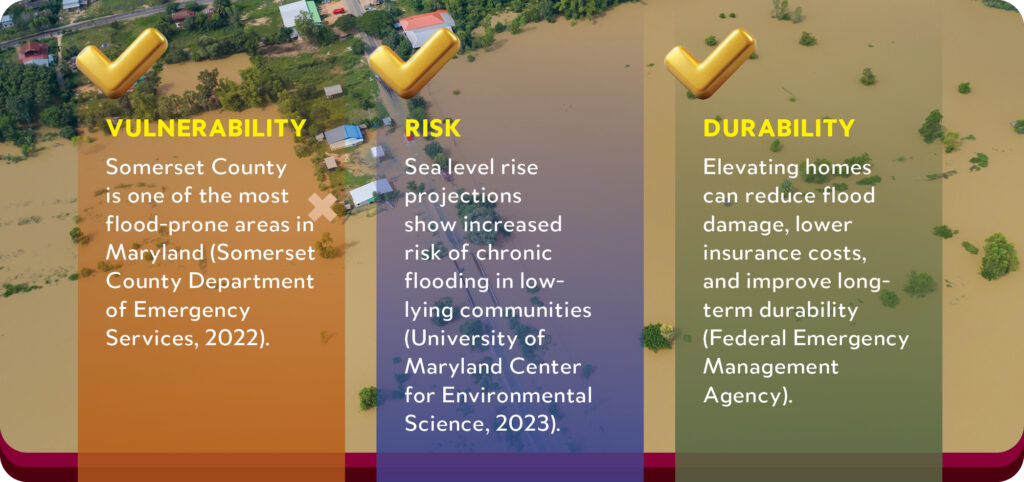
As one of Maryland’s lowest‑lying jurisdictions, Somerset County faces increased risks of property damage, infrastructure disruption, and increased flood‑insurance costs driven by frequent tidal flooding and long‑term sea level rise.
Somerset County is highly vulnerable to flooding due to its extremely low elevation and extensive marshlands, which increase exposure to tidal inundation. Only about 10% of the county lies above 20 feet in elevation (Maryland DNR, 2022). An Environmental Protection Agency assessment further reports that 58% of Somerset County’s 329 square miles falls within a Federal Emergency Management Agency‑designated flood zone (Maryland DNR, 2008).
Maryland has already experienced more than a foot of sea level rise, and current projections show this upward trend will continue. The Sea‑Level Rise Projections 2023 report indicates water levels along Maryland’s shoreline are very likely to rise another foot between 2000 and 2050 matching the increase observed over the entire previous century and could reach as much as a foot and a half (UMCES, 2023). This continued rise further intensifies flood risks for low‑lying coastal areas such as Somerset County.
The county’s Hazard Mitigation and Flood Mitigation Plans highlight chronic inundation in places such as Crisfield, Deal Island, Rumbley, Smith Island, and areas along Tangier Sound and the Manokin River, where low elevations and drainage limitations contribute to recurring tidal and nuisance flooding.
Consequently, elevating homes in these high‑risk zones is a vital strategy for reducing long‑term exposure, strengthening infrastructure durability, and supporting overall endurance of local towns and cities as sea level rise continues to accelerate.
Somerset County faces chronic tidal flooding, accelerating sea level rise, and frequent storm‑driven inundation. Because of this, elevation is a key mitigation strategy identified in the county’s plans. “Elevating” a home refers to raising its lowest floor to or above the base flood elevation (BFE), the height floodwaters are expected to reach during a 1 percent annual chance flood, often referred to as a 100-year flood (FEMA, 2022). Federal floodplain regulations require both new construction and any “substantially improved” or “substantially damaged” structures to meet current standards, including elevation to or above the BFE.
This article details key funding opportunities and technical resources for homeowners, planners, and local officials to support home‑elevation projects across Somerset County.
Funding Sources for Home Elevation
FEDERAL PROGRAMS
Pre-disaster Preparedness
- Flood Mitigation Assistance (FMA): For National Flood Insurance Program-insured properties. Local jurisdictions must apply on behalf of homeowners. According to FEMA: “The Flood Mitigation Assistance grant program is a competitive program that provides funding to state, territory and local governments, and federally recognized Tribal Nations. Funds are used for projects that reduce or eliminate the risk of repetitive flood damage to buildings insured by the National Flood Insurance Program (NFIP).”
Post disaster
- FEMA Hazard Mitigation Grant Program (HMGP): Applies to Somerset County, Maryland, only after the county is part of a disaster area as declared by the president. According to HMGP website: FEMA’s Hazard Mitigation Grant Program (HMGP) provides funding to state, local, tribal and territorial governments to develop hazard mitigation plans and rebuild in ways that reduce or mitigate future disaster losses in their communities. This funding becomes available following a Presidentially declared disaster. Homeowners and businesses are not eligible to apply directly for HMGP grants. However, local communities may apply for funding on their behalf. To receive HMGP funding, all state, local, tribal, and territorial governments must develop and adopt hazard mitigation plans.
- HUD Community Development Block Grant Disaster Recovery (CDBG-DR): May support elevation projects after federally declared disasters. According to the U.S. Department of Housing and Urban Development (HUD): “CDBG-DR grant funds are appropriated by Congress and allocated by HUD to rebuild disaster-impacted areas and provide crucial seed money to start the long-term recovery process. These flexible grants help cities, counties, Tribal Nations, and states recover from presidentially declared disasters.”
MARYLAND PROGRAMS
- The Maryland Department of Emergency Management provides resources, information, and support for emergency preparedness and response.
- Coastal Resilience Program, Maryland Department of Natural Resources (DNR): Offers general resources on coastal hazards planning and preparedness.
- Living Shoreline Resources, Maryland DNR: Offers information, technical assistance, and funding resources for shoreline protection.
- Maryland Emergency Management Association: Provides homeowner guides and grant support for elevation.
LOCAL PROGRAMS
- Somerset County Housing Rehabilitation Program: Offers grants and loans for elevation and flood mitigation. Contact: Casey Goldsborough, housing rehabilitation specialist, 410-651-1424, cgoldsborough@somersetmd.us or Stephanie Underwood, housing loan specialist, 410-651-1424, sunderwood@somersetmd.us
- The Eastern Shore Long-term Recovery Committee within the Maryland Voluntary Organizations Active in Disaster supports recovery for affected residents in Somerset and Dorchester counties, focusing on making homes safe and helping households with ongoing long‑term recovery needs. To qualify, individuals or families must have been impacted by the October 2021 high‑tide flooding event. While water damage from the 2021 flooding event was addressed with immediacy, a significant number of people still lack the financial capacity to undertake more substantive mitigation actions, such as elevating their homes. Consequently, their properties remain vulnerable to recurrent flooding.
Planning Tools and Data
- Maryland Coastal Flood Explorer: Visualize current and future flood risk projections as well as historic events.
- MyCoast Maryland: Document flooding events with photos to support planning.
Policy and Zoning Support
- Somerset County Rising Sea Level Guidance: Includes recommendations for zoning and building code updates to support elevation
- Eastern Shore Climate Adaptation Partnership: Offers model policies and planning tools for sea level rise adaptation
- Guidance for using Maryland’s 2023 Sea Level Rise Projections: Includes tools for choosing your sea level rise projection and applying it to your planning process
Local Contacts and Assistance
- Somerset County Planning & Zoning: For permits, zoning and elevation project guidance
- UMES Lower Shore economic think tank: Offers support for long-term planning and grant applications
- Deal Island Peninsula Partnership: A collaborative partnership working to strengthen community and marsh resilience in the Deal Island Peninsula in response to sea level rise
References
Boesch, D. F., Baecher, G. B., Boicourt, W. C., Cullather, R. I., Dangendorf, S., Henderson, G.R., Kilbourne, H. H., Kirwan, M. L., Kopp, R. E., Land, S., Li, M., McClure, K., Nardin, W., & Sweet, W. V. (2023). Sea-level rise projections for Maryland 2023. University of Maryland Center for Environmental Science. https://www.umces.edu/sea-level-rise-projections
Maryland Emergency Management Agency. (n.d.). Hazard Mitigation Grant Program: Fact Sheet
Maryland Department of Natural Resources. (2022). Somerset County: Land Preservation, Parks and Recreation Plan
Federal Emergency Management Agency. (2020). Guidance for flood risk analysis and mapping MT 2 requests.
Federal Emergency Management Agency. (n.d.). NFIP: Unit 8 – Floodplain management requirements.
Somerset County, Maryland. (2021). Flood mitigation plan overview.
Somerset County, Maryland. (2022). Hazard risk & vulnerability maps.
University of Maryland Center for Environmental Science. Sea level rise projections for Maryland: 2023 report.
U.S. Environmental Protection Agency. (2008). Somerset County, MD: Rising sea level guidance.
Contact
Dr. Nazia Arbab is assistant professor with the University of Maryland Eastern Shore and UMES Extension agribusiness/resource economics specialist, nnarbab@umes.edu; Christine Burns is coastal planner with Chesapeake & Coastal Service, Maryland Department of Natural Resources, christine.burns1@maryland.gov
This effort was made possible through funding from the National Oceanic and Atmospheric Administration Office for Coastal Management awarded in 2024.
This article was published May 27, 2026.
