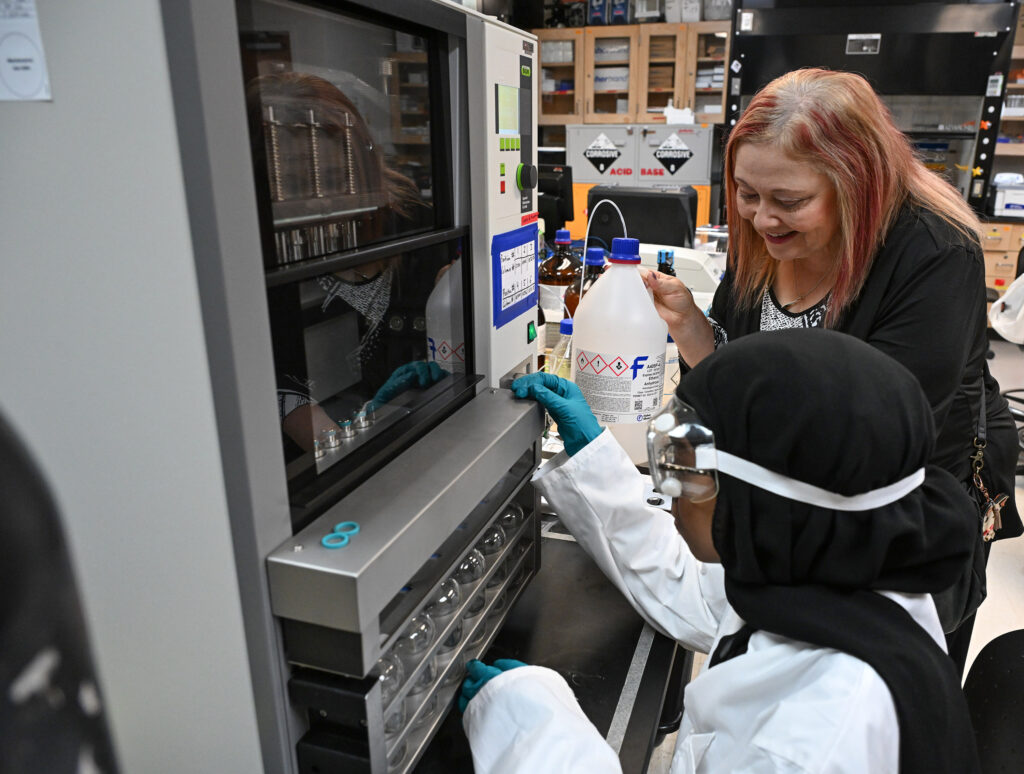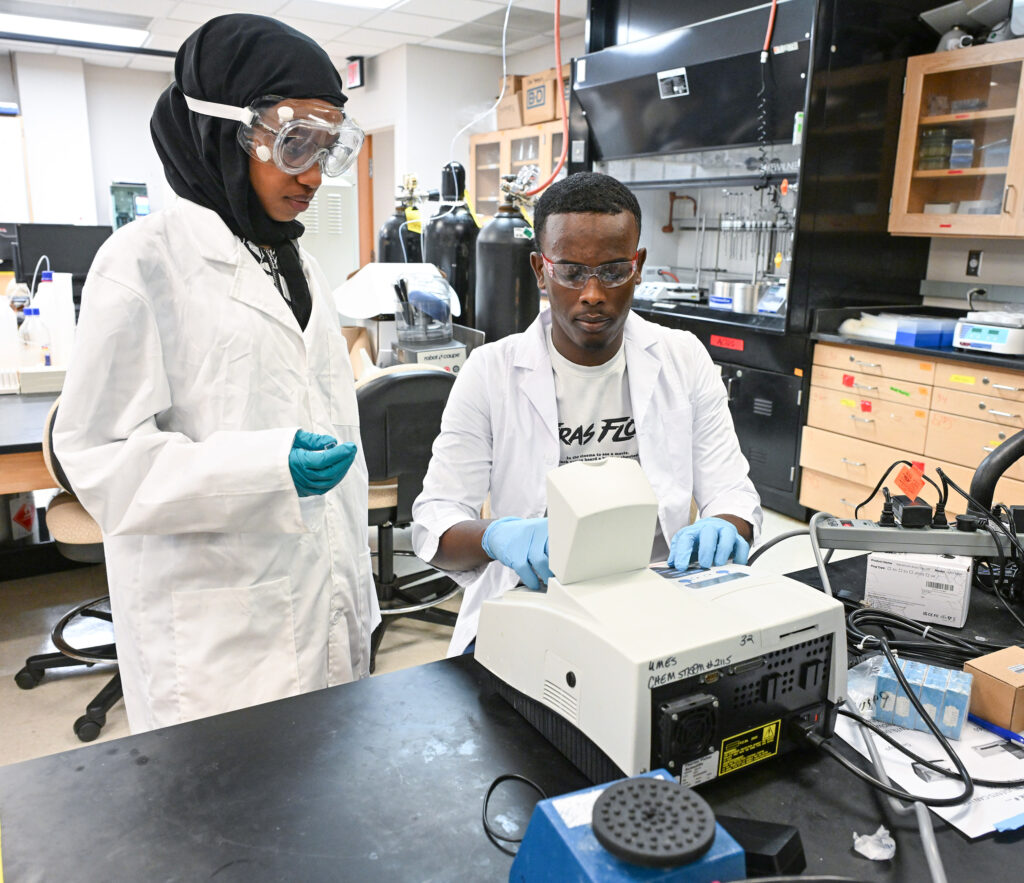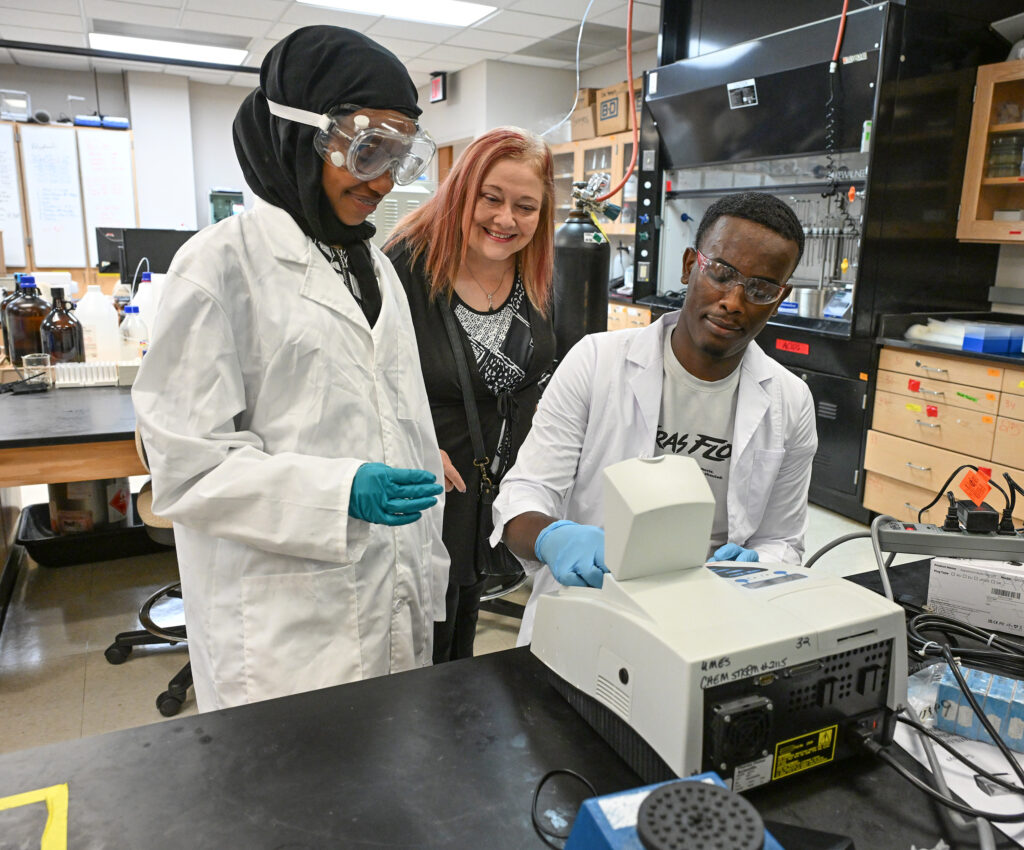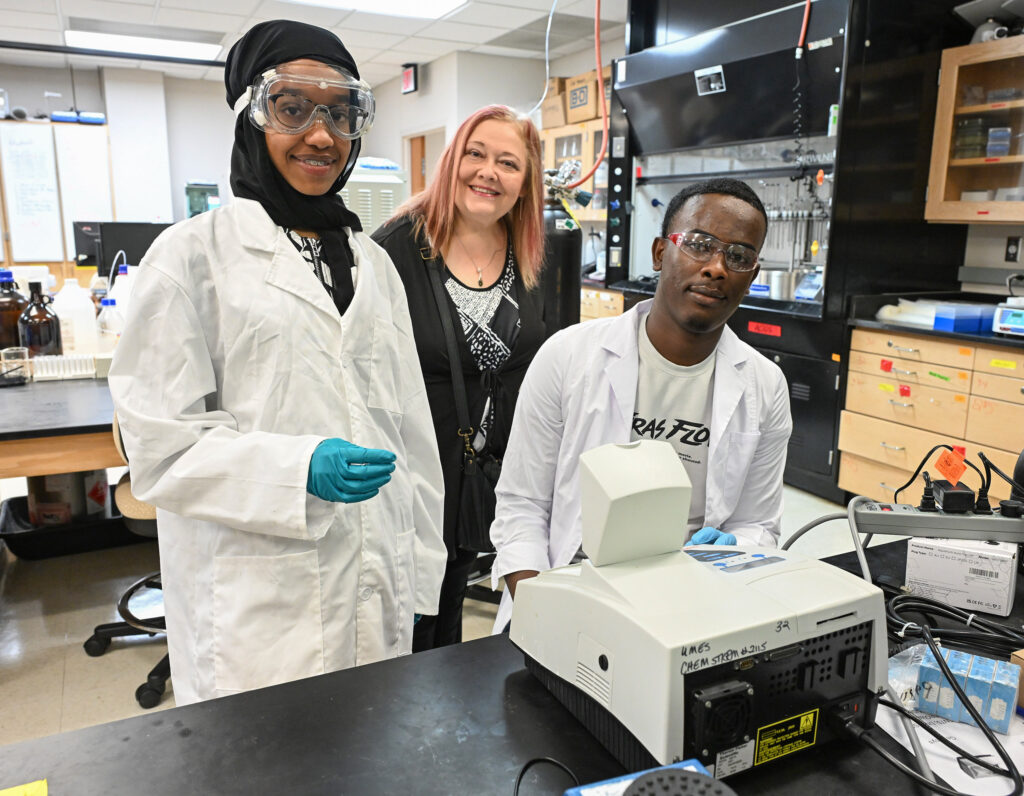
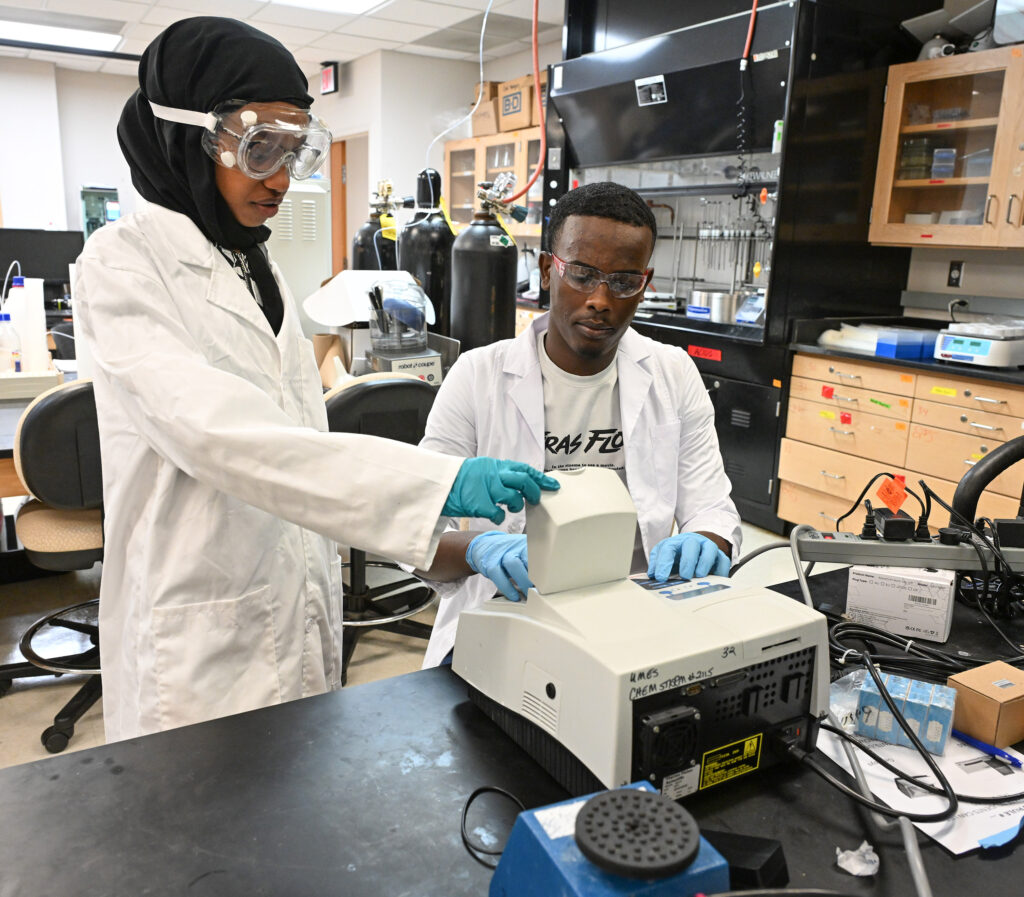
This summer was a trifecta of first-times for two rising seniors at Washington High School: being on a college campus, having a summer internship, and learning how to conduct and present research alongside faculty and graduate students.
The Somerset County students participated in an eight-week summer program at the University of Maryland Eastern Shore through the American Chemical Society’s Project SEED program.
Nour Hassan’s zest for chemistry was fueled by her first time on a college campus in a “real research lab.” Having done experiments in her high school science class, she was pleased to conduct experiments with the expanded autonomy afforded in the university setting.
“In a high school lab, you have a teacher and they tell you exactly what to do. But in a research lab, there is more freedom to think on your own to figure out the steps and do the experiment, and I like that,” Hassan said.
With the added freedom also comes responsibility.
In order to earn their stipend for the summer experience, certain criteria must be met, such as producing a research report and a poster that will be presented at the ACS National Meeting in Washington, D.C., on Aug. 17-21, according to UMES chemistry professor Victoria Volkis, coordinator of the program for the past 12 years.
Another highlight of her summer internship, Hassan said, was “using spectrophotometry to find the polyphenols and flavonoids in samples of ginger.” Realizing the “biological benefits of the bioactive compounds” and seeing for herself how they can be applied impressed her.
For fellow intern Mohammad Siddiq, it was the wow factor.
“When we were running the samples and adding different chemicals to them, the reactions were really cool,” Siddiq said. “Some changed color, some changed temperature and some created steam.”
Siddiq, who plans to apply to UMES, like Hassan, was also surprised to learn how chemistry can be applied in the real world, particularly agriculture.
Along with ginger, the summer researchers were introduced to Aronia berry studies and value-added products the Volkis lab is involved in. The two learned about a project UMES graduate student Keith Bratley is undertaking.
“He did a lecture for us and shared his research on an Aronia-berry power drink. It was interesting to learn about a different plant and we tried and rated samples for the project,” Siddiq said. “I liked seeing how the science can address health issues.”
With both plants, Siddiq said in addition to learning about the health benefits, he also like seeing “how it can be planted, harvested and brought to people.”
“It gives you a head start where college stands, which is very helpful,” Siddiq offered.
Each summer, the program supports about 350 aspiring young scientists with paid research internships to promote college readiness, professional development, lab preparedness and exposure to careers related to chemistry.
“The summer internship was a good opportunity,” Hassan said, “because this school does research and research goes online so many people benefit from that,” Hassan said. “Not all colleges produce research, and I think it’s a really good advantage to go to UMES.”
If the two decide to enter in the UMES Freshman Class of 2026, Volkis shared there are scholarships, such as the UMES Land-grant Scholarship, that may help pay for tuition and many programs within the School of Agricultural and Natural Sciences to help ensure their success. Project SEED students are eligible to apply for an ACS scholarship that could award them $5,000 toward tuition their first year of college.
Gail Stephens, agricultural communications, University of Maryland Eastern Shore, School of Agricultural and Natural Sciences, UMES Extension, gcstephens@umes.edu, 410-621-3850.
Photos by Todd Dudek, agricultural communications, University of Maryland Eastern Shore, School of Agricultural and Natural Sciences, UMES Extension, tdudek@umes.edu.