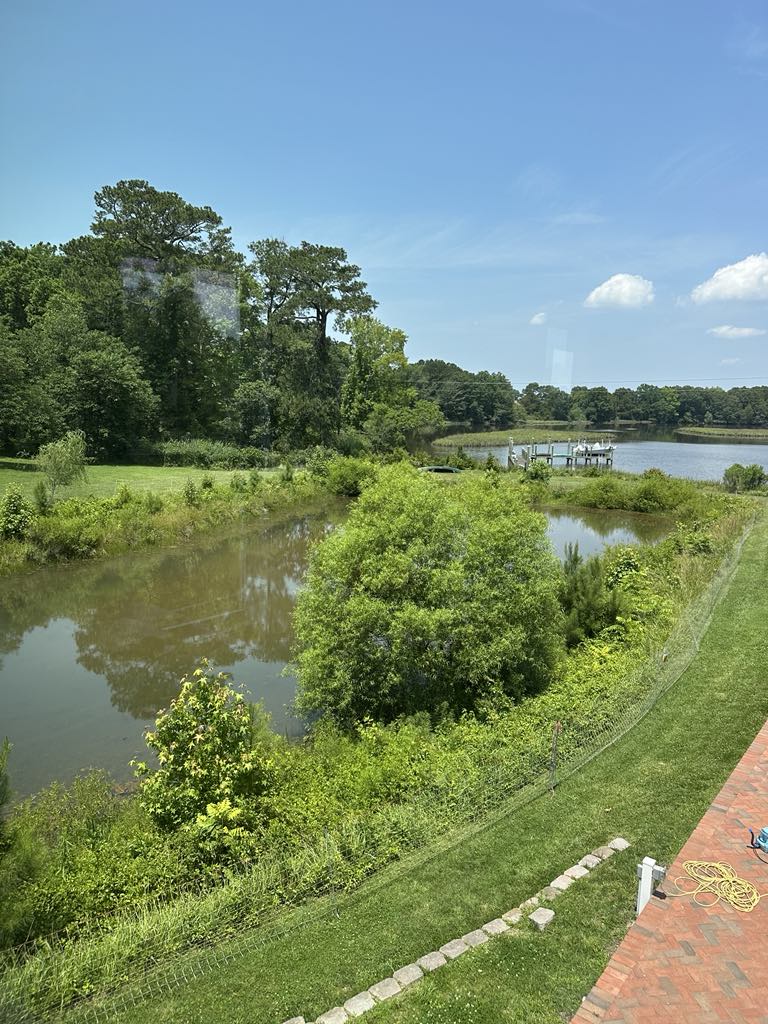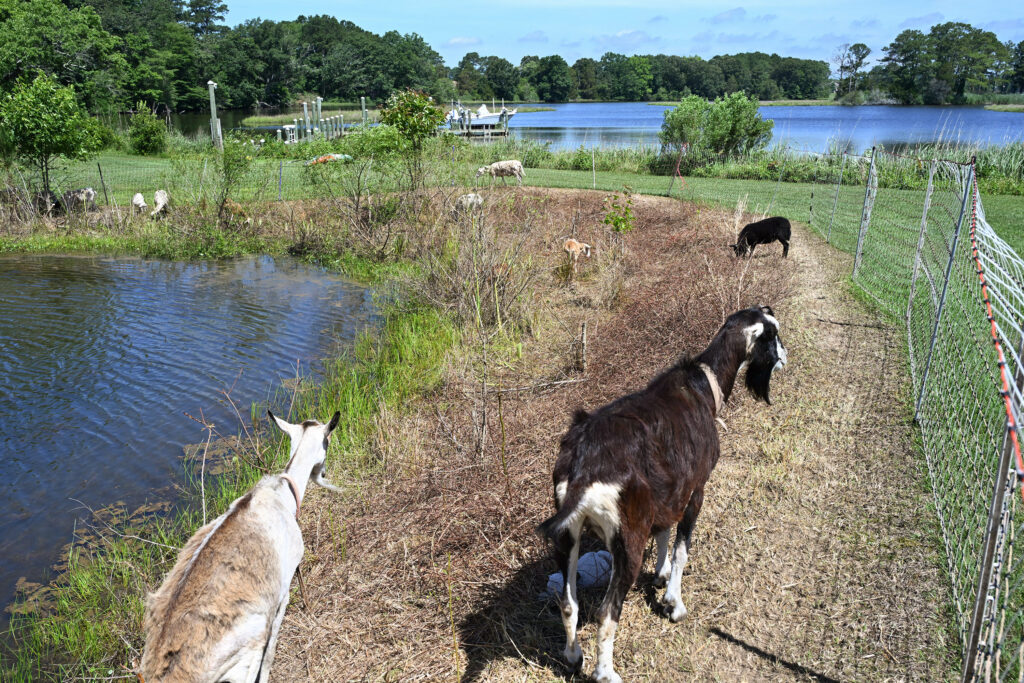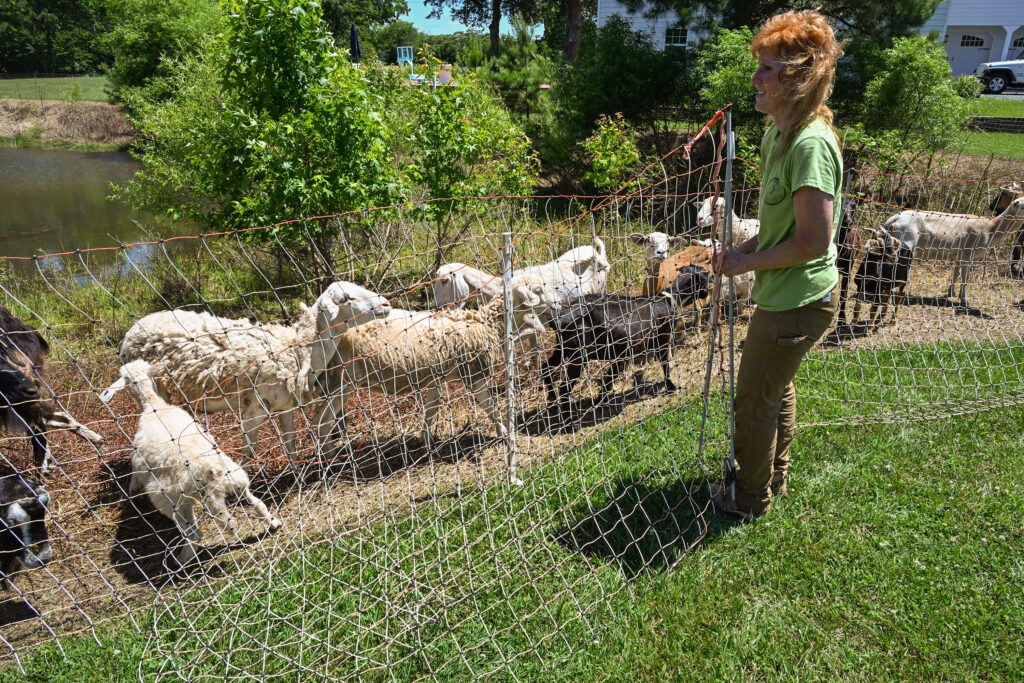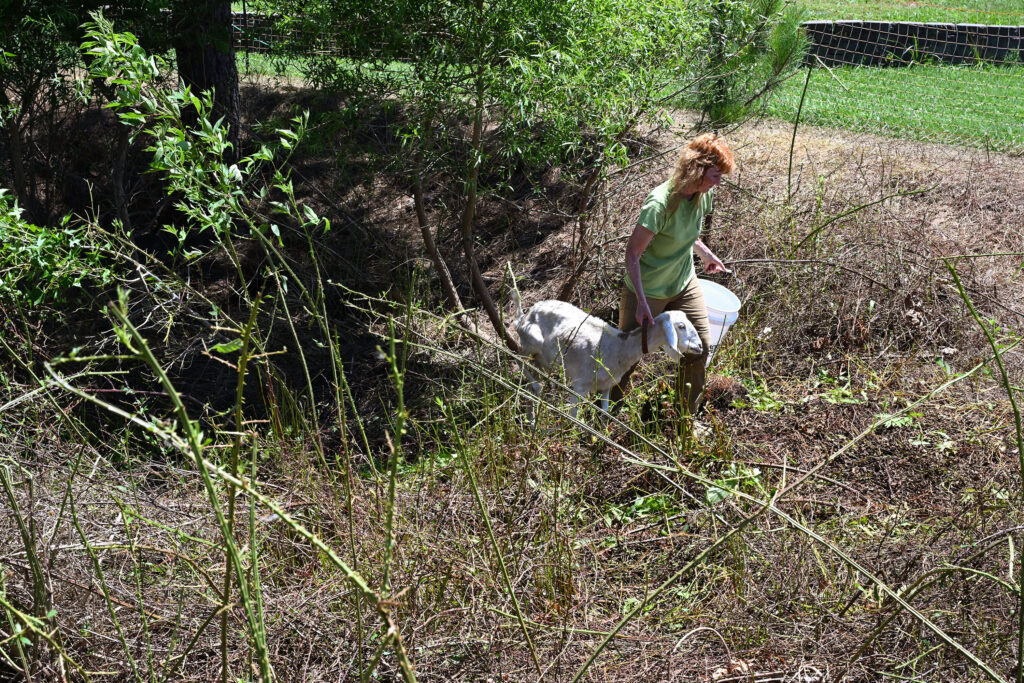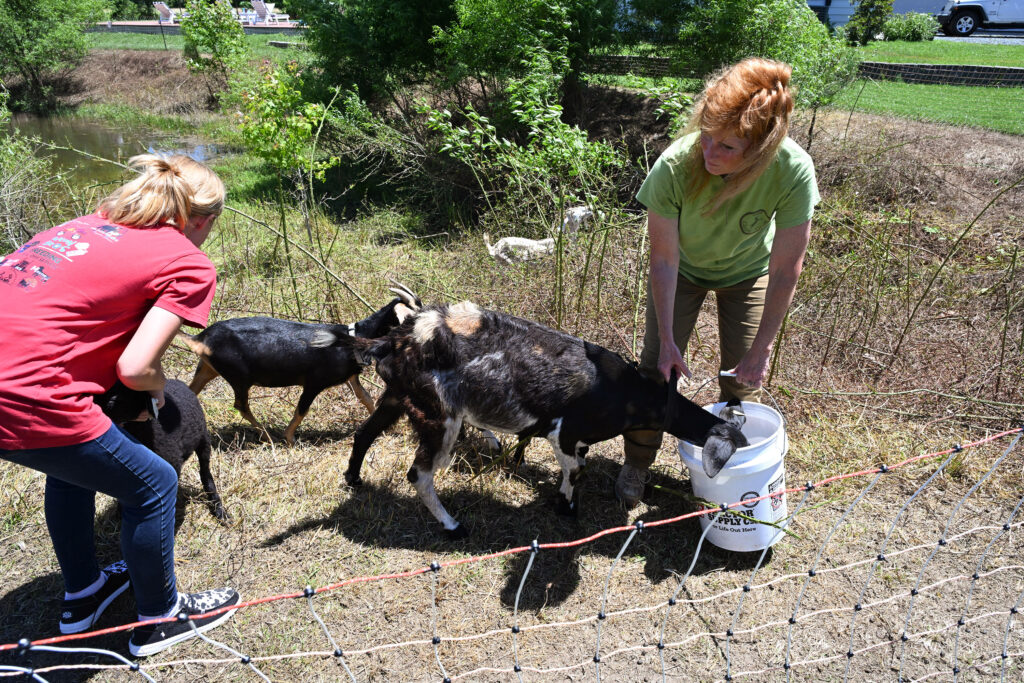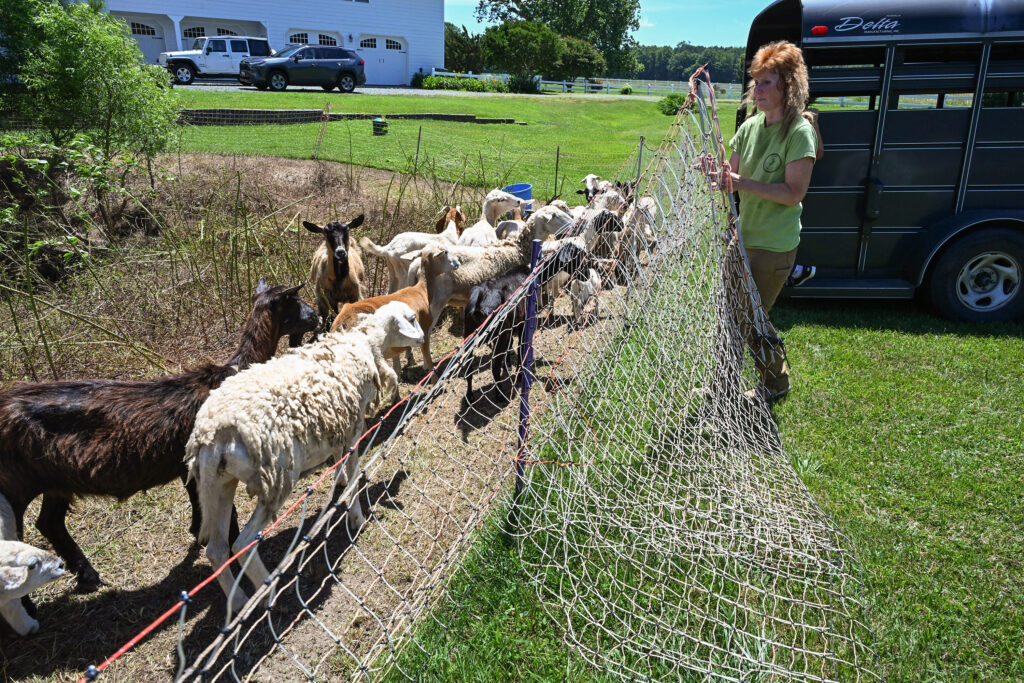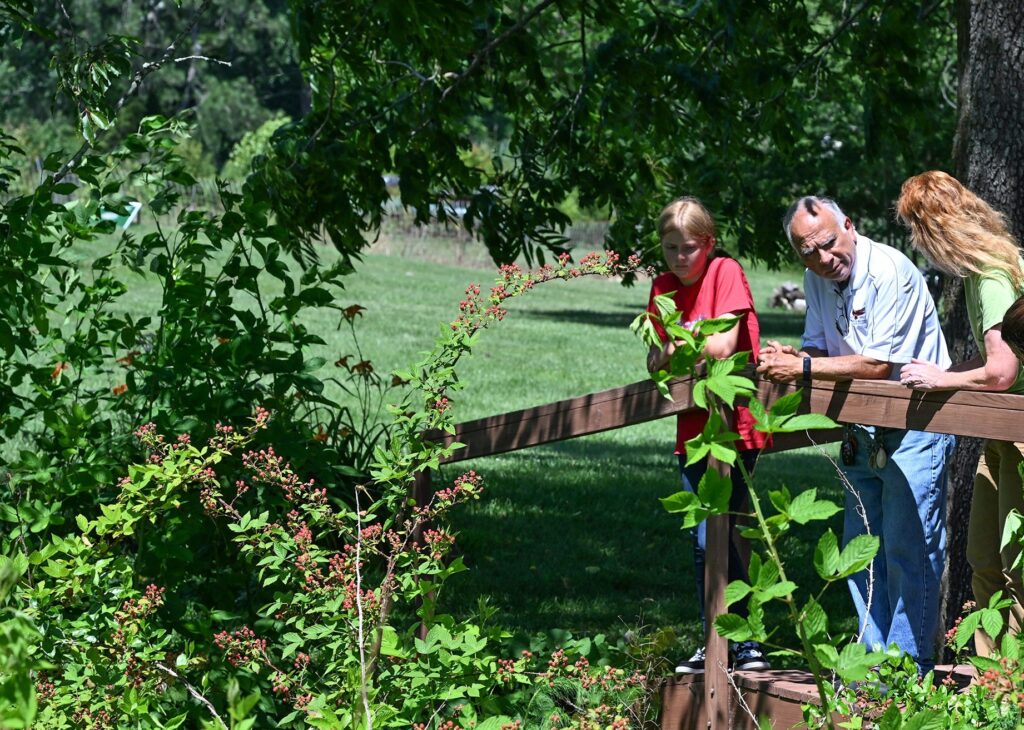
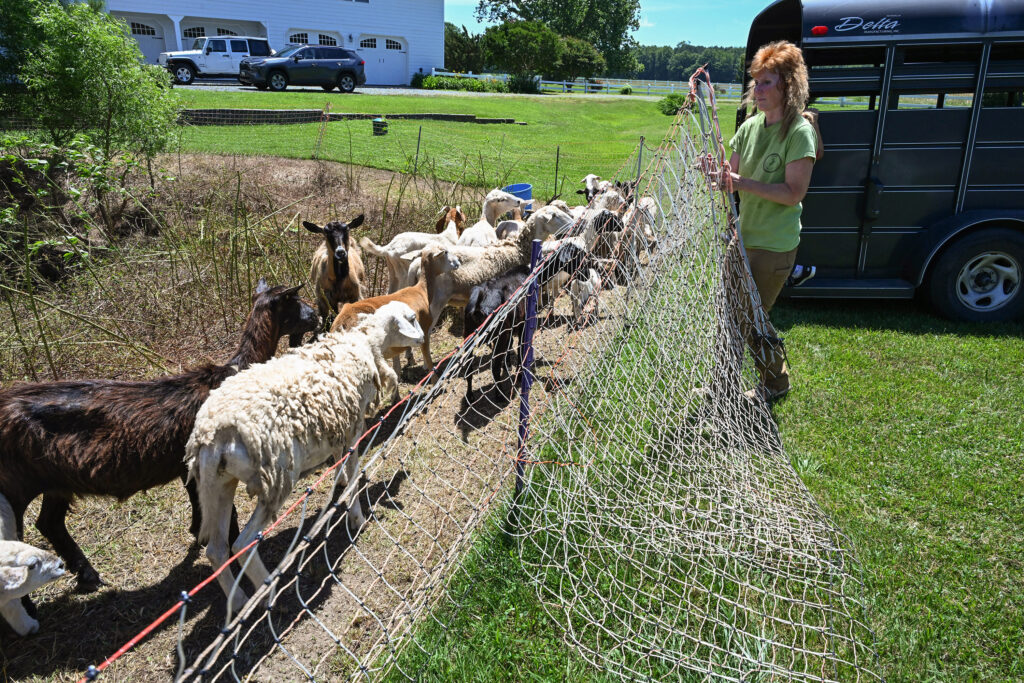
When Mary Bowen, owner of Browsing Green Goats, set a herd of goats to browse on a Somerset County property to clear unwanted vegetation around a pond near the river, it was with 15 years of experience and a partnership with UMES Extension’s Dr. E. Nelson Escobar behind her.
Yes, that’s right, goats are browsers, not typically grazers.
Bowen attended one of Escobar’s small ruminant training sessions on artificial insemination in 2010, when they learned of their similar interests.
“He asked me why I had so many goats, and I told him that I wanted to get into clearing using them. ‘Why?’ he said. I answered that I saw what goats can do with firebreaks in California to help prevent wildfires and wondered what I could do in Maryland and Virginia. Realizing we are surrounded by water, I researched setting the goats and sheep near waterways. I thought it could help everyone get away from using glyphosate, a chemical herbicide, near the Chesapeake Bay and its tributaries,” said Bowen, a self-proclaimed environmentalist.
Escobar, associate dean for extension and small ruminant specialist at UMES, dove in, helping the agricultural entrepreneur learn how to set fencing and what it would take to implement projects. Bowen’s inquiry fortuitously coincided with a capacity building grant (USDA/NIFA) awarded to Escobar to study the use of sheep and goats to manage unwanted vegetation.
“I appreciated her interest in what we were doing,” Escobar said. “We talked a couple of times about ideas and the experiences we had during the study, the culmination of which was a workshop on the subject matter. Mary took it to the next level and made it a successful business.”
Bowen credits UMES Extension for her plans coming to fruition.
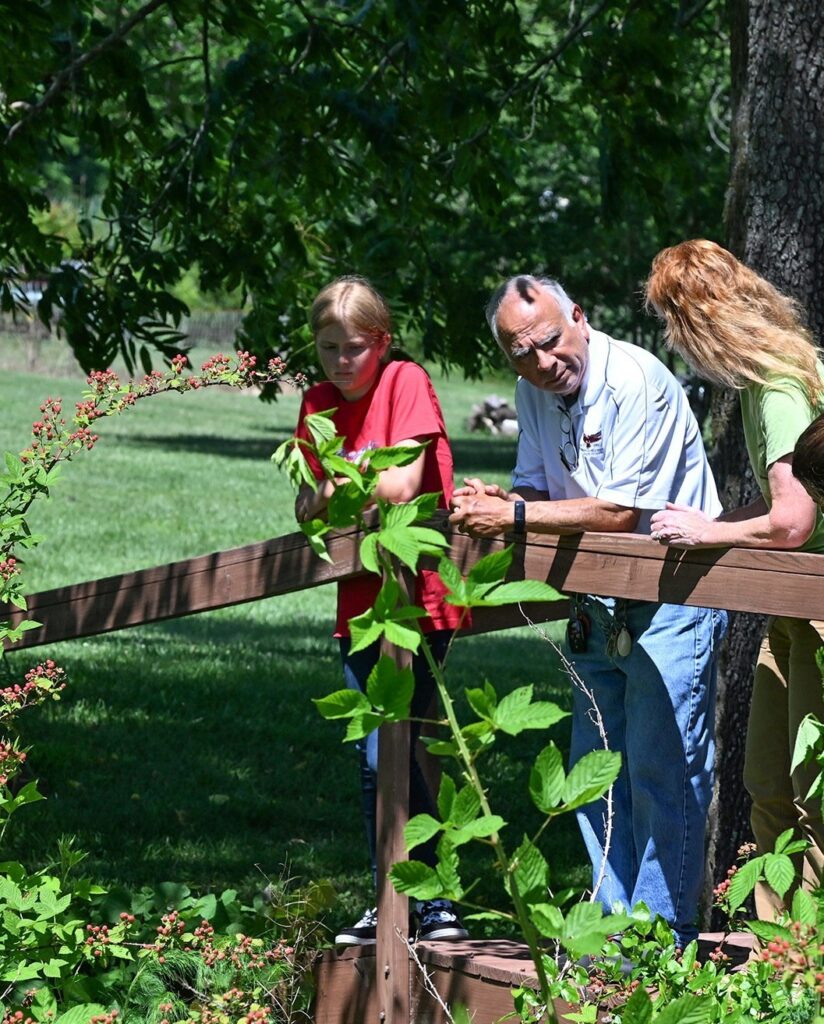
“If it hadn’t been for Dr. Escobar, I wouldn’t have had the momentum to keep going when times got tough, especially when it was just me working the projects,” she said.
Bowen now takes on vegetation clearing projects from a half-acre up to 20 acres with her eco-friendly four-legged landscapers, as she likes to call them. In a typical year, she can complete 15-20 jobs from April to November.
After supplying her clients with a “goatstimate” based on size, density and time needed for clearing, she deploys the animals in places where mowers can’t be used like environmentally sensitive sites and where people don’t want to work, especially when it involves removing invasive plant species like poison ivy, oak and sumac, along with wisteria, kudzu and multiflora rose.
Her knowledge about poisonous plants in pasture has become so extensive that the relationship is reciprocal with Escobar consulting many times with Bowen on the “noxious weeds.”
The businesswoman doesn’t take on clearing jobs smaller than a half-acre because “that’s usually in someone’s backyard and involves English ivy, which I don’t feel is the best use for the sheep and goats,” she said. “That’s what Dr. Escobar taught me, was that it had to be on a larger scale in order to be good stewards of the environment. That’s what it’s really all about.”
Bowen’s values are evident in her catchy marketing slogans, “spraying isn’t cool” and “invasive species control while saving the environment one goat at a time.”
“You also have to be profitable,” Escobar chimed in. “If you can’t make a profit, it’s not worth doing it.”
The two collaborators are currently waiting for the opportunity to “get our hands on GPS-based virtual fencing system for rotational grazing,” Escobar said. “Using artificial intelligence techniques, it will greatly help in targeting specific areas for vegetation management using sheep and goats.”
Gail Stephens, agricultural communications, University of Maryland Eastern Shore, School of Agricultural and Natural Sciences, UMES Extension, gcstephens@umes.edu, 410-621-3850.
Photos by Todd Dudek, agricultural communications, University of Maryland Eastern Shore, School of Agricultural and Natural Sciences, UMES Extension, tdudek@umes.edu.