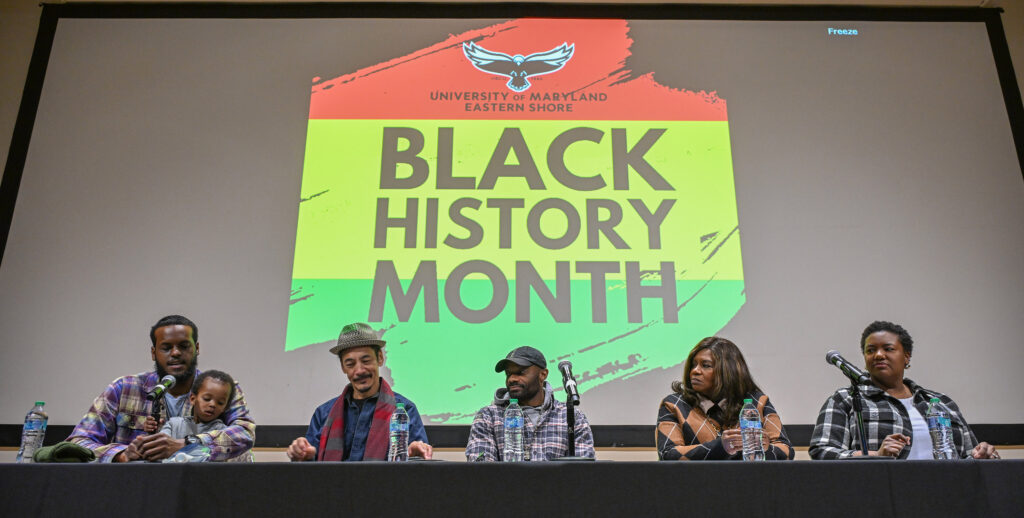
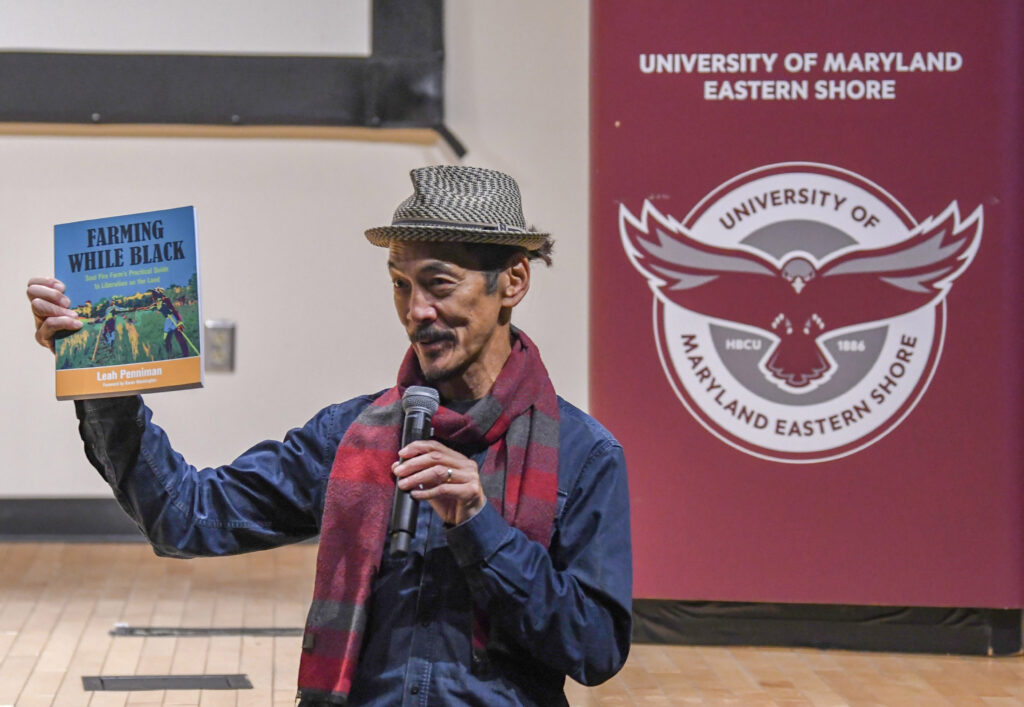
This event stood out for San Francisco-based film director Mark Decena (at right) among the 200 screenings across the country of “Farming While Black.” It was his first time accompanying the film to take part in a post-screening panel discussion at a historically Black college or university.
“I’m excited to be here at an HBCU to share this story about the rising and returning generation of Black farmers. I’m very pleased that the documentary’s audience now includes many allies in the food sovereignty and Black land movements,” said Decena, a three-time Sundance Film Festival alumnus.
The feature-length film, shown as part of the University of Maryland Eastern Shore’s Black History Month activities, sheds light on the plight of the nation’s Black farmers. At its height in 1910, Black-owned farms accounted for 14% of U.S. farms compared to less than 2% today.
The main characters in the — farmers Leah Penniman and her sister Naima of Soul Fire Farm in upstate New York, Blain Snipstal of Earth-Bound Building in Southern Maryland and New York City urban farmer Karen Washington of Rise & Root Farm, — encourage the next generation to reconnect with their agricultural heritage and ancestral connection to land.
Penniman’s book of the same title was the impetuous for the documentary. The goal, she said in the film, was to contain information useful to the Black farming community. The family’s Soul Fire Farm holds aspiring growers’ trainings, a subsidized farm food distribution program for communities in food deserts and organizes for equity in the food system.
“I was hungering for a film about solutions. I read the book and connected with Leah’s message about changing the way we treat land and food,” Decena said during the discussion at UMES.
Snipstal traveled across the Chesapeake Bay to be a member of the post-screening panel along with two Black area farmers who take part in UMES Extension programs, Thelonius Cook and Taiesha Hyacinth. An organic farmer for more than 10 years who draws on his Georgia-based heritage and travels to explore international farming, Snipstal coined the term “agroecology.” He describes it as a core concept, a set of ideas, to speak to the Black experience and food justice.
Apart from Black and indigenous people, “no one’s talking about culture, just food production,” Snipstal said. “Without culture, there is no agriculture.”
“To understand who we are as a people, can only be learned from folks that have experienced it ancestrally,” he said in response to an audience question.
Cook is now in his 11th year farming in Birdsnest, Virginia, and serves as board president of the 100-member Mid-Atlantic Black Farmers Caucus. He said that as a young farmer it was important to “seek out each other, form connections and keep in touch” to share experiences and help one another.
“There’s a gap because we had been severed from this ancestral knowledge. I wish I had learned more, asked more (of his grandparents),” Cook said.
Hyacinth, owner of Caribe Locavore Farm in Dover, Delaware, validated the purpose of Black farming networks Cook spoke of.
“It’s bringing all of those skill sets together, finding true passions and using it collectively,” she said. “We are greater together than apart.”
Hyacinth grows a variety of alternative crops, including callaloo, okra, scotch-bonnet peppers and herbs. Her farming connects “families to the flavors of their heritage and creates pathways for cultural preservation and food security.”
“Educating ourselves to right certain wrongs is so empowering,” she said. “We were told to move away from land and do something more technical,” said Hyacinth, who worked in the corporate world of finance for 20 years before turning to farming. “But by cultivating things from our culture like recipes and herbal medicines, we are finding out who we are and who we can be.”
This Black History Month event was sponsored by the University of Maryland Eastern Shore’s School of Agricultural and Natural Sciences, Extension and Department of English, Languages and Media Studies, along with the Campbell Foundation and Salisbury University.
Gail Stephens, agricultural communications and media associate, University of Maryland Eastern Shore, School of Agricultural and Natural Sciences, UMES Extension, gcstephens@umes.edu., 410-621-3850.
Photos by Todd Dudek, agricultural communications, University of Maryland Eastern Shore, School of Agricultural and Natural Sciences, UMES Extension, tdudek@umes.edu.