
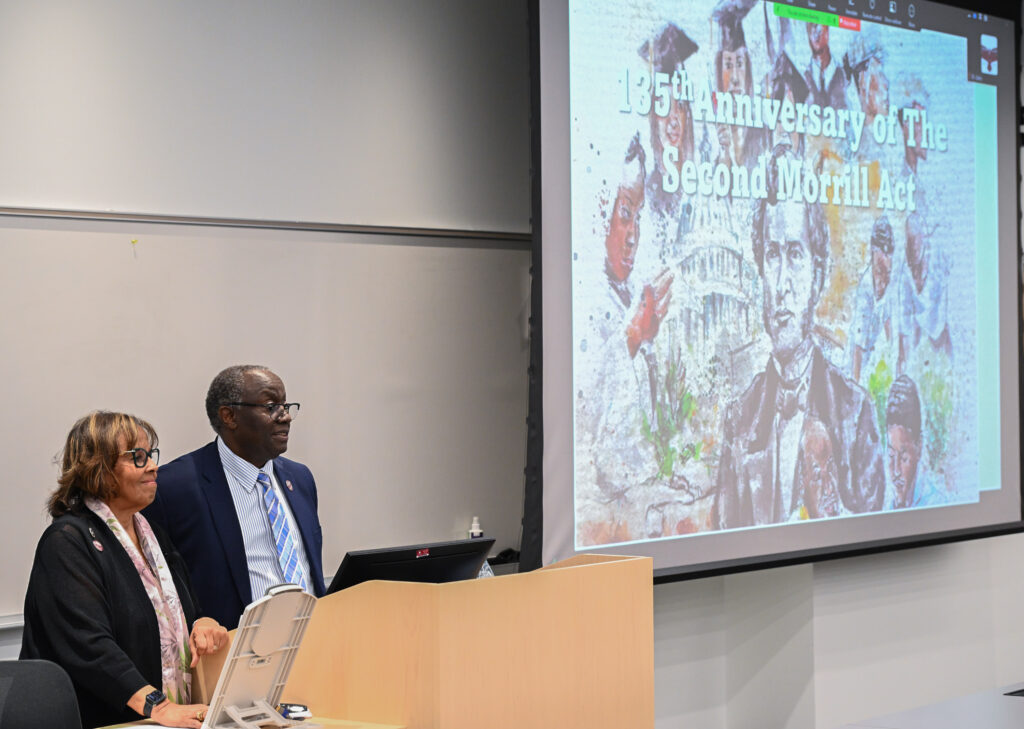
As the University of Maryland Eastern Shore celebrates 135 years of being an 1890 land-grant institution, understanding the importance of that designation remains vital, as Dr. Carolyn Brooks (far left) urged during a talk.
Brooks, who had a three-decade career at the Princess Anne university has a wide-ranging experience in higher education relating to research, teaching and extension serving as chair of the agriculture department, before becoming dean and then chief of staff to the president. Holding degrees from Tuskegee and The Ohio State universities, she is the proud product and champion to the nation’s 19 Black land-grant universities.
Her breadth of knowledge about the law that shape the land-grant universities system, the Second Morrill Act of 1890, was the highlight of her School of Agricultural and Natural Sciences spring seminar on April 29. [To watch her speech in full, click here.]
“Dr. Brooks has played a critical role in the land-grant system,” said Dr. Moses T. Kairo, presiding SANS dean.
Named for the U.S. senator from Vermont who supported land-grant legislation, Justin Morrill, the act expanded on the first version signed by President Abraham Lincoln in 1862 to develop college level instruction for “the practical realities of an agricultural and industrial society,” Brooks said. Each state was granted 30,000 acres for the purpose, which is where the terminology land-grant originates. Twenty-eight years later when the Civil War ended, the second piece of legislation passed allowing the institutions to be accessible to all, or allowing for separate, but equally funded, colleges.
“We don’t take, we give back,” Brooks said of the $7 billion in economic impact the 19 Black land-grant institutions contribute today to local, state and national economies. “The research that is done is with the applied aspect in mind. That’s what Morrill wanted us to do, to do work with the people and to do the work of the people.”
The professor emerita, who previously served as executive director of the Association of Research Directors, noted the importance of staying at the forefront of today’s farming industry as more than 51% of all degrees awarded to African Americans in agriculture are from an 1890 institution.
“While agricultural sciences might not always get the same spotlight as high-tech or medical sciences, it’s important to remember that agriculture is deeply integrated with cutting-edge technology. We also have the explicit responsibility of service to our communities though cooperative extension, from genetic engineering to precision farming to sustainable practices and data-driven solutions.
“Agricultural sciences are as sophisticated and forward-thinking as any other scientific field. In fact, they’re at the forefront of tackling some of the world’s greatest challenges,” said the professor emerita.
Brooks urged land-grant universities to stay true to their mission now and in the future.
“As we recognize this 135th anniversary, please remember who and what brought us to the dance,” Brooks concluded.[To watch her speech in full, watch this video.]
Gail Stephens, agricultural communications, University of Maryland Eastern Shore, School of Agricultural and Natural Sciences, UMES Extension, gcstephens@umes.edu, 410-621-3850.
Photos by Todd Dudek, agricultural communications, University of Maryland Eastern Shore, School of Agricultural and Natural Sciences, UMES Extension, tdudek@umes.edu.
