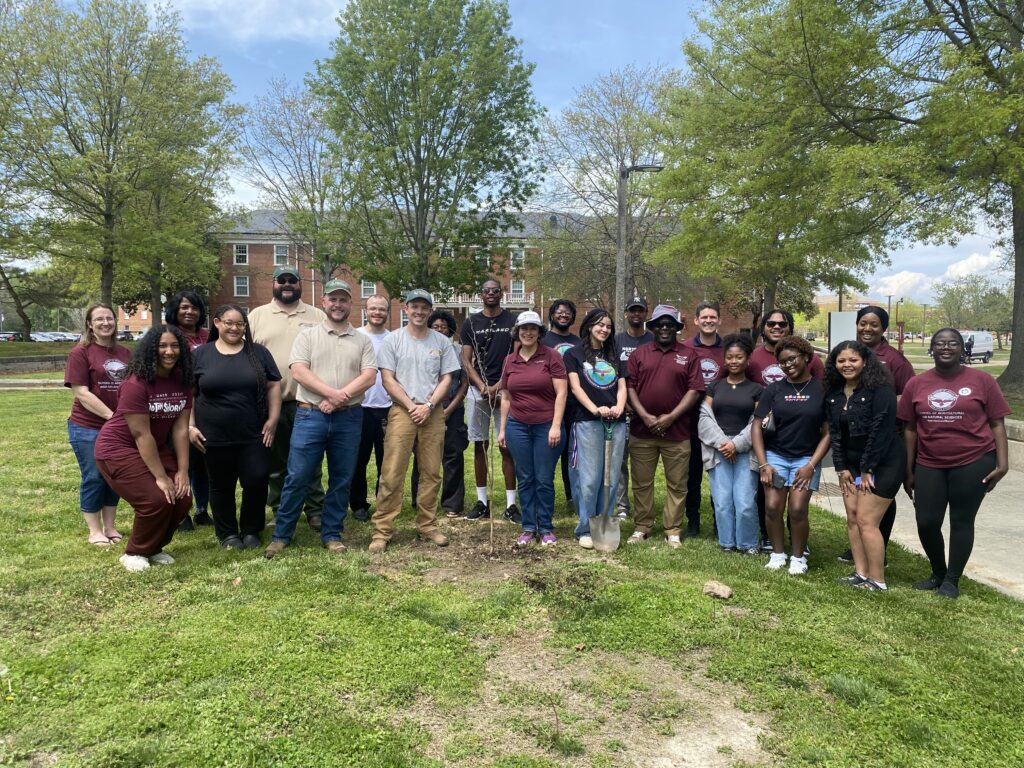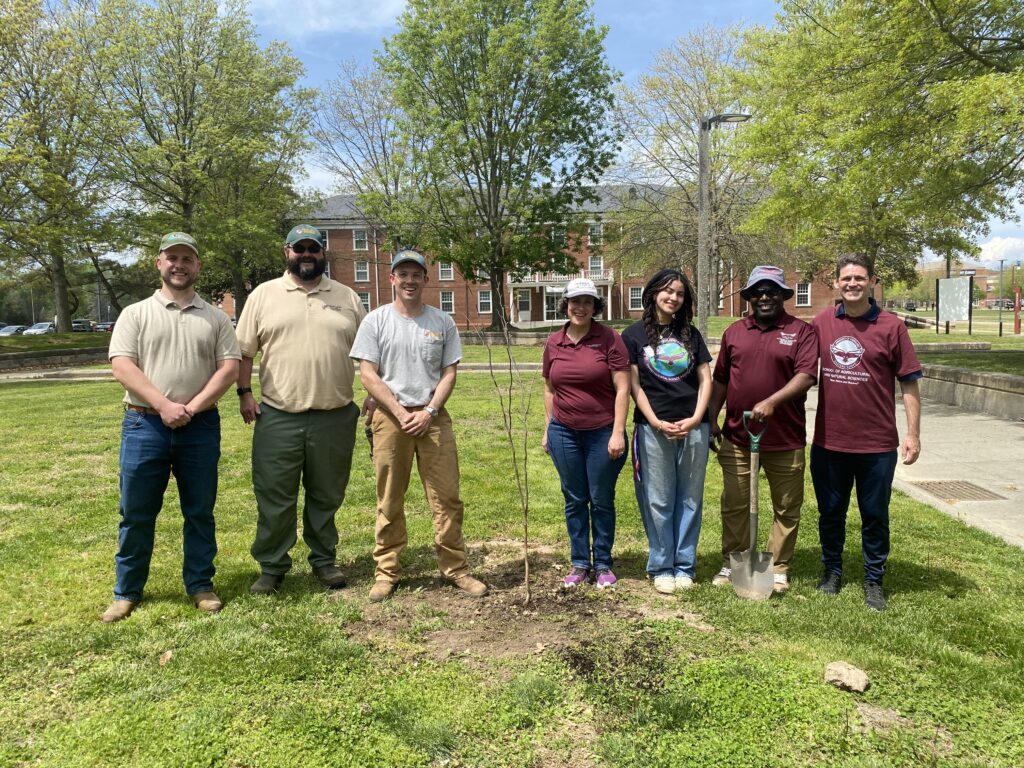
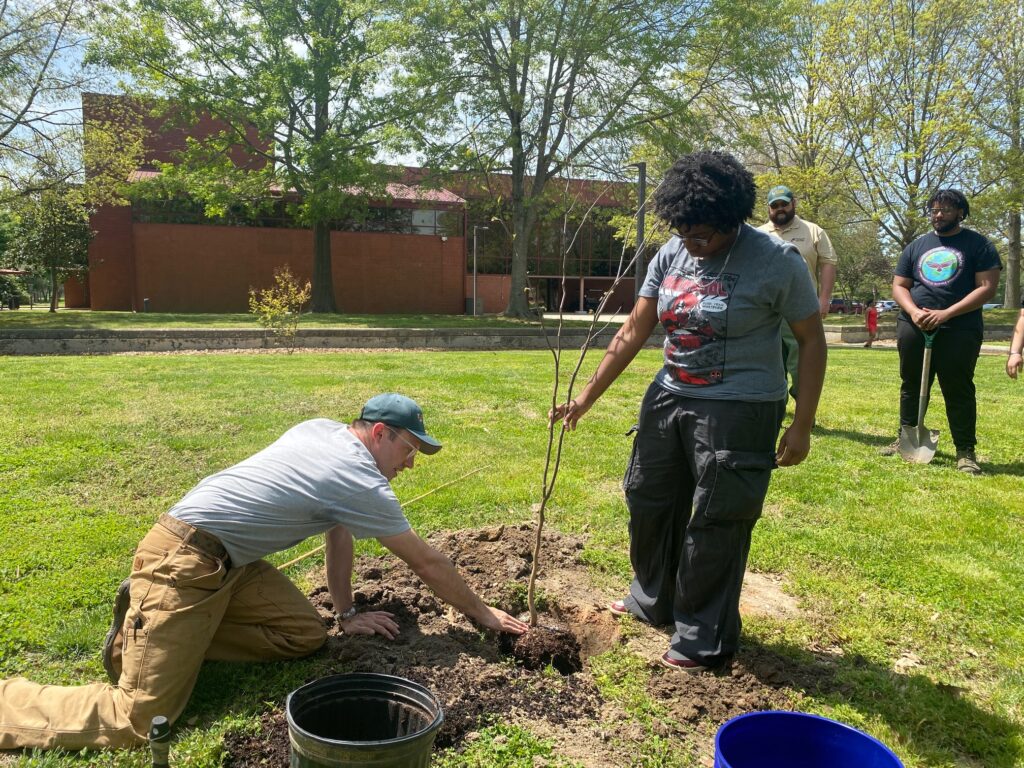
Earth Day 2025 started out with the proverbial April shower, but quickly cleared to a brilliant, sunny spring day in time for the University of Maryland Eastern Shore’s observance. Each year, the university enlists the help of the Maryland Department of Natural Resources Forest Service for a tree planting to maintain its designation as an Arbor Day Foundation Tree Campus.
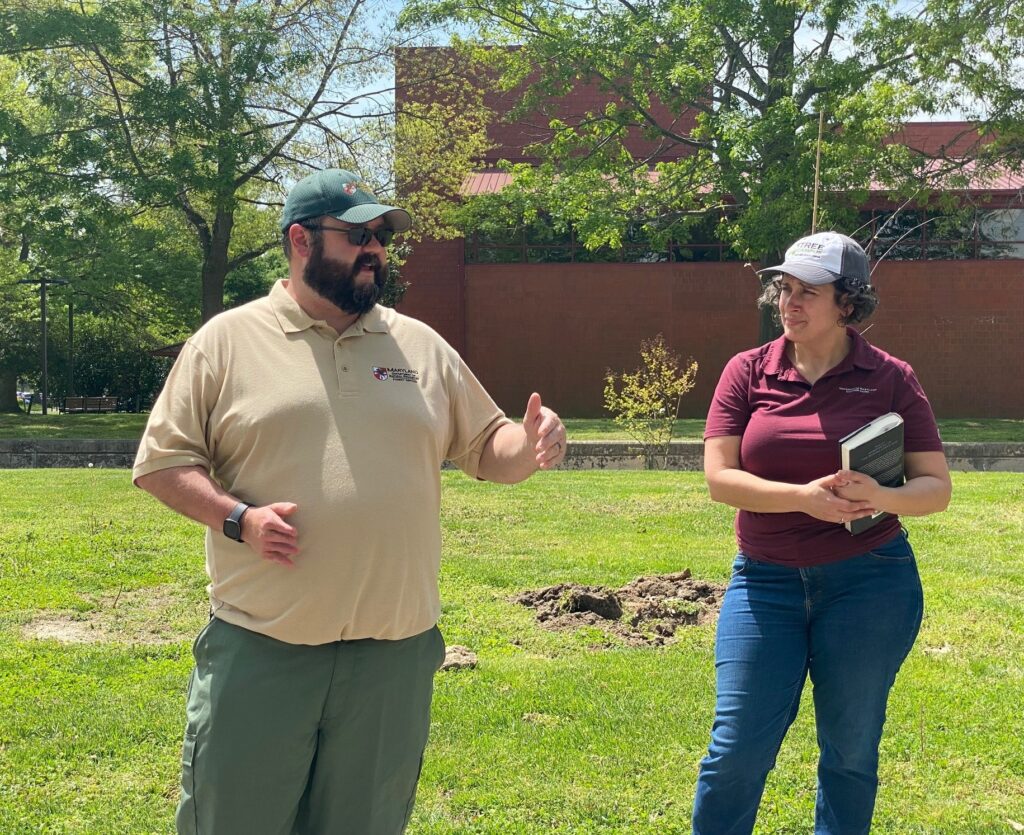
“Two years ago, Bradford pear trees stood behind us,” said Stephanie Stotts (below, at left), an associate professor of forest ecology at UMES. “If you’ve ever been around them, you’ll notice that they have a potent unpleasant smell. They are also an invasive species and can cause environmental harm. Today, we are replacing them with a native tree, a current focus in forestry that benefits the environment.”
Stotts is leading the charge in the university becoming a certified arboretum not only for the enjoyment and ecological benefits of trees but as a hub for community education and industry professional training.
By planting an Eastern redbud in its place, the campus community can still enjoy beautiful spring blooms but without the problems associated with invasive species, said Matthew Hurd (below clockwise, center at left) , eastern regional forester with Maryland DNR Forest Service.
Hurd has been on hand the past four years to help facilitate and procure a tree for the campus celebration. This year’s installation was preceded by different varieties of red maples and a seedling cloned from the state’s historic Wye Oak that stood in Wye Mills, Maryland, for 400 years.
“This is a nice culmination to what we like to refer to as Arbor Month, since we observe Arbor Day at the national level on the last Friday of April and the first Wednesday for the state,” Hurd said. “When UMES signed on as a Tree Campus, it was the first year for any historically Black college in Maryland and among only a few HBUCs nationally with the designation.”
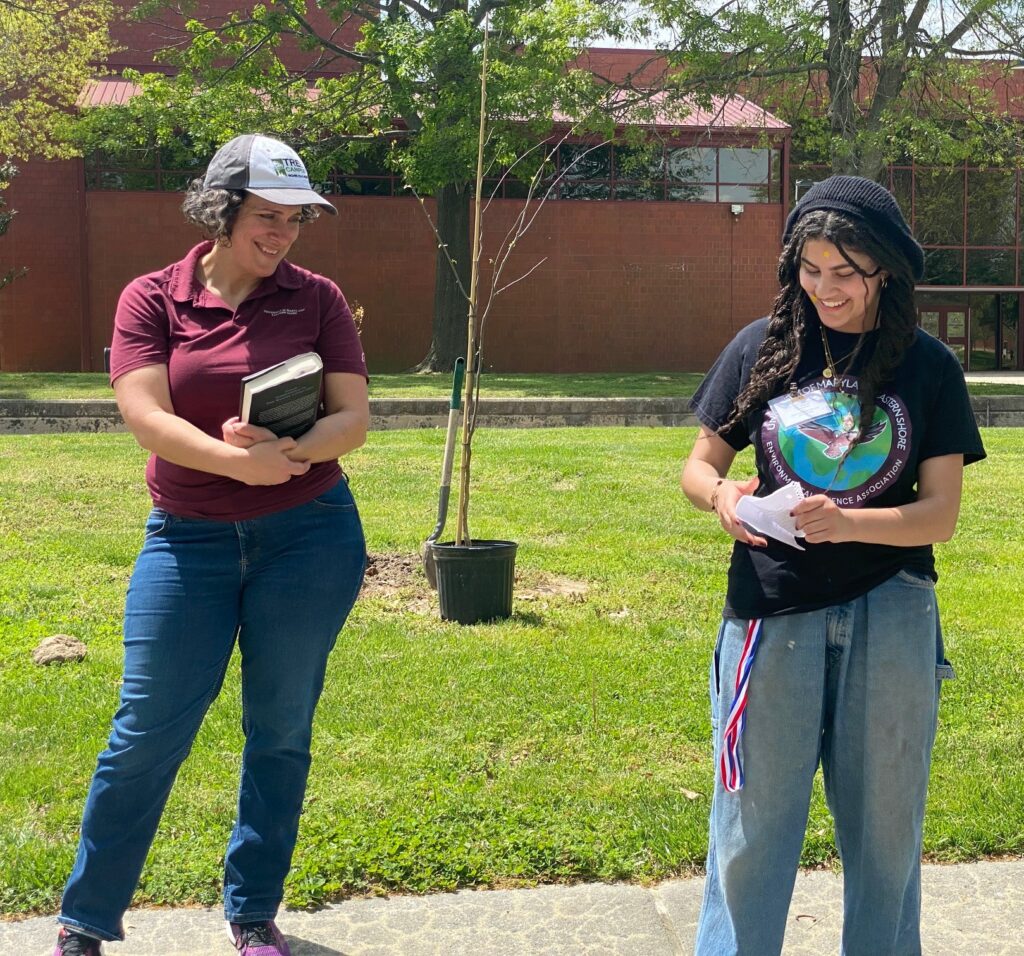
For members of UMES’ student Environmental Science Association like Sarah Rawlinson (far right), it is also a special day.
“Today, we plant more than a tree — we plant action, awareness and responsibility. Just as this tree will grow and shape its environment, so will we through science, education and community,” said the junior majoring in environmental science.
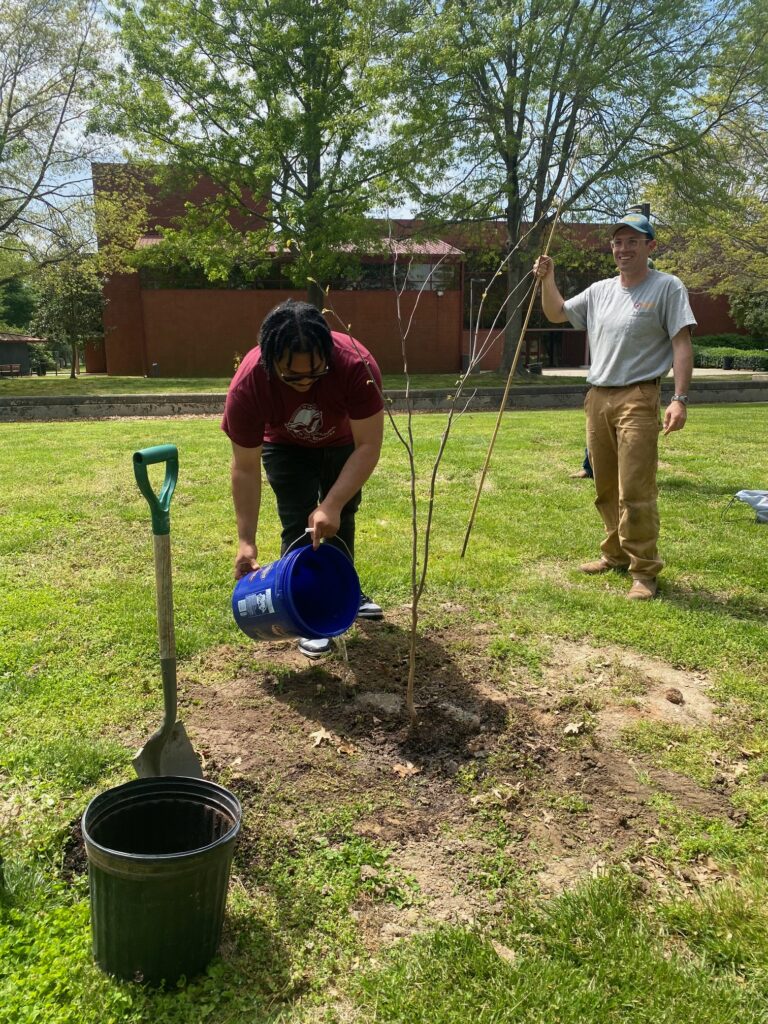
The event proved to be a learning experience for some of the onlookers as Jarrett Hoskins (above, left), a coordinator with the Maryland Forest Service’s 5 Million Tree Planting Program, demonstrated proper planting techniques.
Trees like more width than depth, he explained, and cautioned against planting too deeply or using what he calls the volcano method of mulching. Instead, he advised the root ball should be at ground level to allow it to be exposed to air with the mulch more in the shape of a doughnut.
An observant student asked why the bamboo stake that had been supporting the tree as it grew in the container was removed when placed in the ground.
“Great question,” Hoskins said. “It’s like training wheels on a bike. Once it is in the ground, the tree needs to support itself. It would be weaker in the future if not as it will have to experience wind and other weather. It’s an example of survival of the fittest.”
Dr. Moses T. Kairo, dean of the School of Agricultural and Natural Sciences, said, people often don’t recognize the need to keep the long term in mind.
“We need to build things that will make a difference in the future. It’s having that mindset and getting more students, our future generations, to recognize the value.”
Gail Stephens, agricultural communications, University of Maryland Eastern Shore, School of Agricultural and Natural Sciences, UMES Extension, gcstephens@umes.edu, 410-621-3850.
Photos by Kara Nuzback, agricultural communications, University of Maryland Eastern Shore, School of Agricultural and Natural Sciences