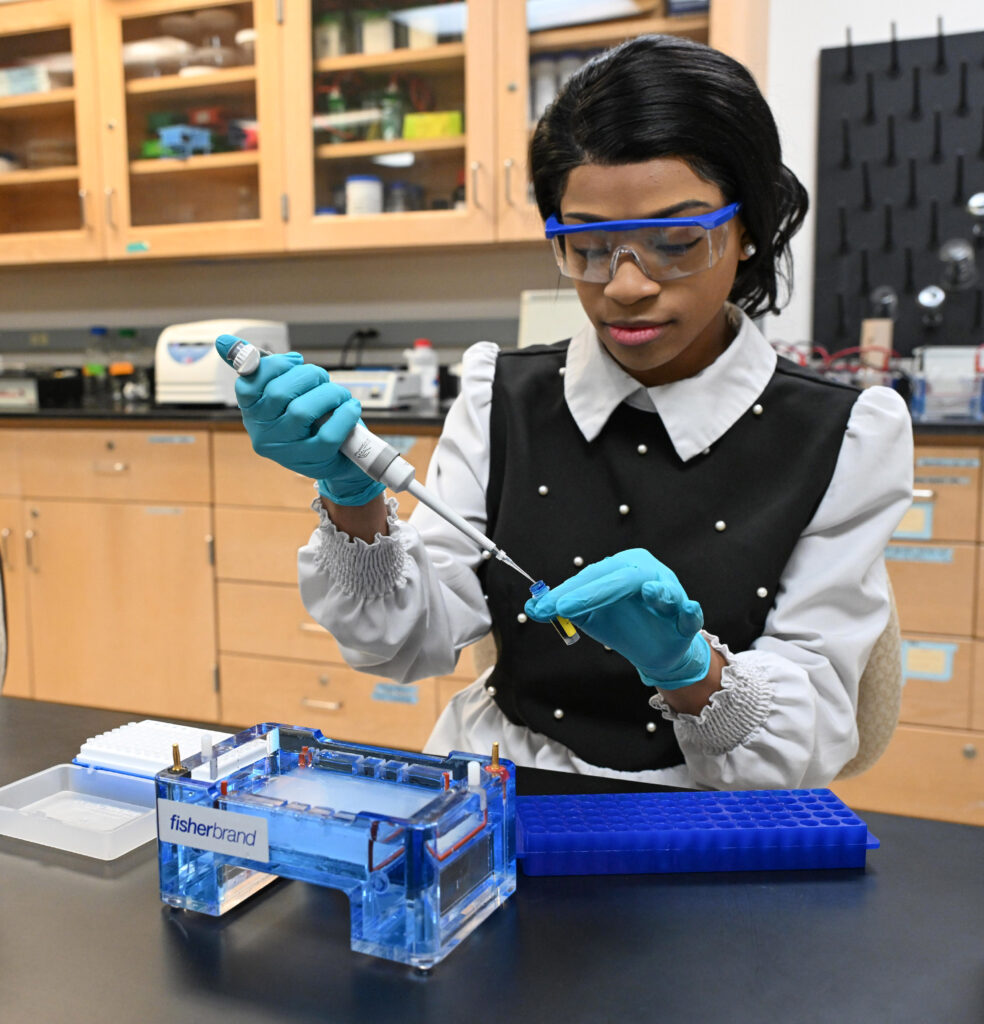
Graduating senior Alexandria Camp (at right) recalls sitting before the TV engrossed in watching popular dramatized crime shows as a youth. It wasn’t the charismatic or quirky main characters, or the plot twists, but the “meticulous work of the lab technicians” that caught her interest. The UMES biochemistry major, who will earn her bachelor’s degree Dec. 13, is now on her way to achieving her dream of a career in forensic science.
“Attending UMES has supported my goals by strengthening my academic skills, connecting me with valuable mentors and resources, and providing real-world experiences that have helped shape my career path,” Camp said.
The Department of Natural Sciences biochemistry curriculum provided the undergraduate with a strong laboratory foundation in biology, cell biology, genetics, biochemistry and microbiology, along with physics and chemistry.
“These hands-on courses helped me apply scientific concepts to real experiments and strengthened my technical abilities,” she said.
Camp has performed cell culture, bacterial transformation and fractionation, gram staining, PCR, DNA and RNA extraction, electrophoresis and spectrophotometry, to name a few.
She expanded her analytical skills and scientific work overseas during an honors research experience in Sunyani, Ghana. There, she studied how temperature and water body type affect turbidity.
Camp’s aptitude for biochemistry earned her a nod as UMES’ nomination for the American Chemical Society’s 2025 Outstanding Undergraduates in Biochemistry. She was one of four recipients from Maryland among those selected from universities with ACS-approved programs across the nation. Awardees are chosen based on excellence in coursework, research, service to the program and an intent to pursue a career in the field.
The native of White Plains, Maryland, attributes her success in part to the support provided as a UMES Land-grant Scholar over the course of her four-year academic career in Princess Anne.
“The UMES Land-grant Scholarship Program has been instrumental in supporting my academic and career goals,” Camp said. “Its financial assistance allowed me to focus on my studies.”
She is a believer in giving back.
“Alexandria is not only an exceptional student, she is also a valued member of the greater School of Agricultural and Natural Sciences community. One of her outstanding qualities is her dedication to supporting her peers. She regularly uses her free time to tutor students in Biochemistry I and Organic Chemistry, subjects she has mastered and remains current with,” said Logan Quinn, SANS coordinator for recruitment, retention and experiential learning at UMES.
“I love the moment when something clicks for someone,” Camp said. “Tutoring not only lets me support others, it also helps me deepen my own understanding, practice patience, and develop teaching and leadership skills.”
After graduation, Camp will pursue a master’s degree in forensic science at Towson University, where she has been accepted for Fall 2026.
“Science produces evidence, and evidence produces justice. This connection between scientific discovery and its impact on society is what draws me to the field of forensic science. I’m particularly interested in the way the field integrates science, law and ethics,” she said.
Her advice to those who will follow in her footsteps: stay engaged both in and out of the classroom; take advantage of internships, training in labs, research opportunities and clubs as they deepen your understanding and strengthen your resume; and don’t hesitate to build professional relationships with professors and advisors who can guide you.
Gail Stephens, agricultural communications and media associate, University of Maryland Eastern Shore, School of Agricultural and Natural Sciences, UMES Extension, gcstephens@umes.edu., 410-621-3850.
Photo by Todd Dudek, agricultural communications, University of Maryland Eastern Shore, School of Agricultural and Natural Sciences, UMES Extension, tdudek@umes.edu
