
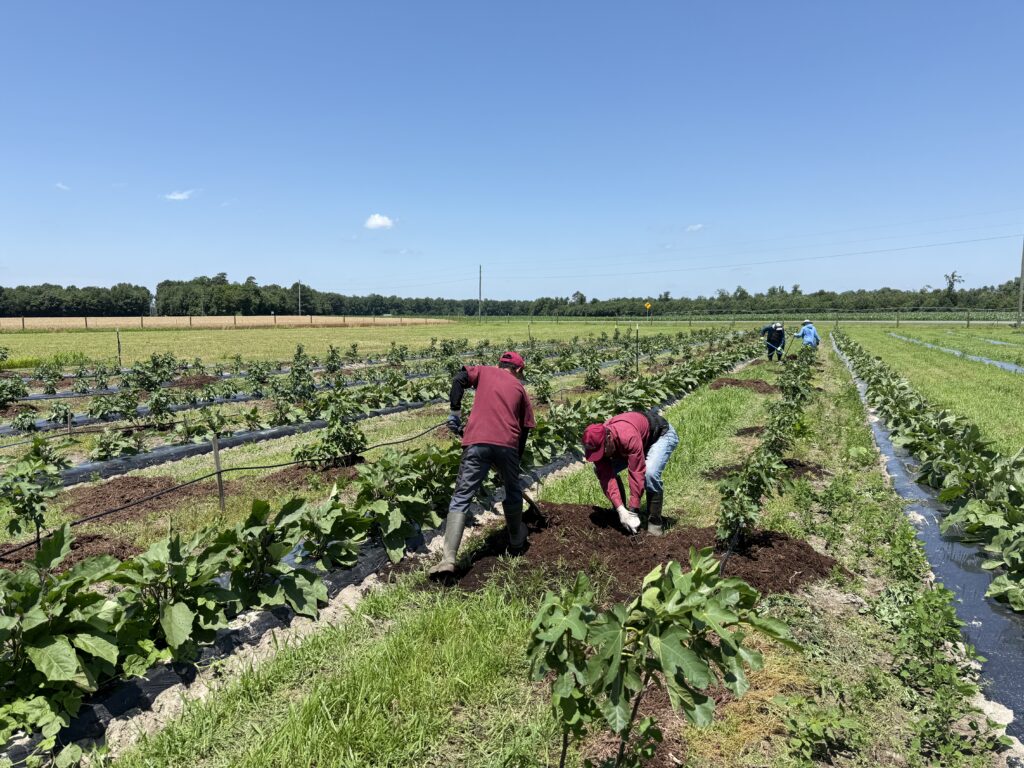
UMES Extension taught small-scale farmers in its service region about alley cropping and associated ecologically friendly practices.
Alley cropping involves planting vegetables or herbs between rows of fruit trees or shrubs, said Lila Karki (far right), an associate professor of agricultural economics and extension specialist. The agroforestry practice can provide farm income streams through cultivation of a variety of profitable crops, while improving soil and air health.
Karki worked individually with farmers to establish 11 on-farm demonstration sites as well as four in community spaces, and hosted training workshops and field days. He highlighted companion crops that work well in the system, how farmers can utilize land efficiently and ways to reduce water consumption, fertilizer and other production costs.
At one of the farm demonstration sites, a seasoned alternative crop grower in Somerset County, Maryland, planted nearly 100 pecan trees in rows on an acre with squash, eggplants, bell peppers and cantaloupes between the rows. She found squash and cantaloupe outperformed.
In Caroline County, Maryland, a 21-year-old beginning farmer piloted a fig-based (131 trees) alley cropping system on his family’s farm. The Crisfield (Maryland) Community Garden featured an apple, peach and fig tree-based system, while a Somerset County high school planted a fig and persimmon-based system in a garden.
Some of the agricultural practices adopted were rainwater harvesting, drip tape irrigation systems, composting, application of natural mulch, minimal tillage, cover cropping and integrated pest management, Karki said.
Gail Stephens, agricultural communications, University of Maryland Eastern Shore, School of Agricultural and Natural Sciences, UMES Extension, gcstephens@umes.edu, 410-621-3850.
Photo submitted.
