
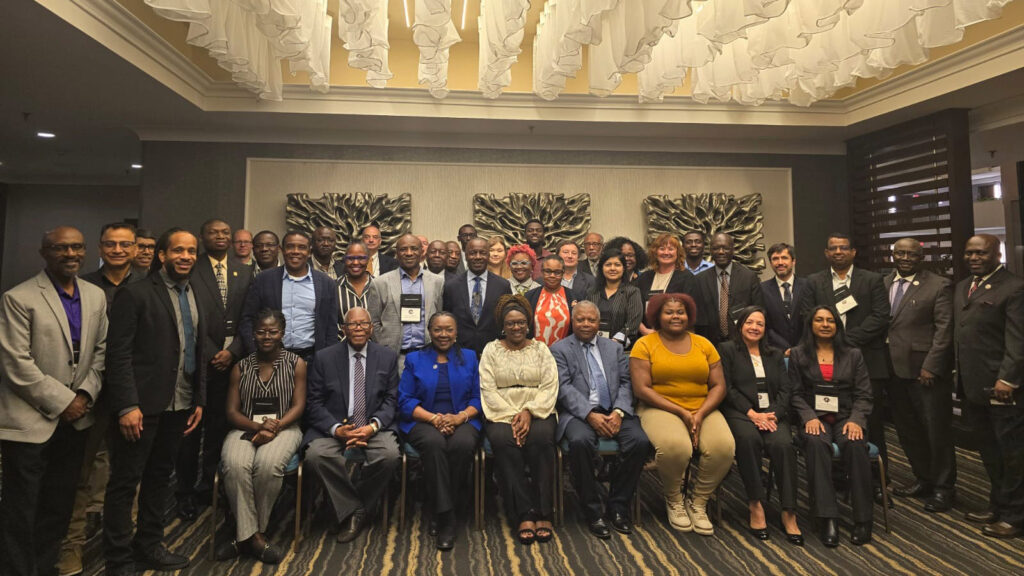
CEIED: Impact Assessment participants pose for a picture.
The Center of Excellence for International Engagement and Development (CEIED) impact assessment summit occurred in Atlanta, Georgia, on June 12-14, 2024. The event brought together food and nutritional security experts, Center partners, and stakeholders to discuss the impact of the CEIED projects, learn from the evaluators’ findings, and help guide the development of the strategic direction for the Center’s current and future activities.
The summit goal was twofold: address global food security challenges using bold ideas with global partners and evaluate the activities carried out by the CEIED in the last four years.
The evaluation of CEIED projects informed the Center’s Directors of the CEIED accomplishments. It provided the path forward for managing and sustaining the Center of Excellence for Global Food Security and Defense. The 12 CEIED projects were evaluated based on specific indicators, including:
- Increasing the supply of globally trained degree recipients in the FANRHS disciplines by innovatively integrating a study abroad/study at home learning, discovery, and engagement curriculum into the 1890 undergraduate and graduate educational experience.
- Strengthening of collaborative and integrative multidisciplinary, multi institutional, research and extension activities involving 1890 institutions and international partners that address global food and nutritional security challenges.
- Developing a robust infrastructure that will leverage the collective 1890 human and cyber capital and partnerships to support the growth and delivery of the Center’s international programming.
Keynote address
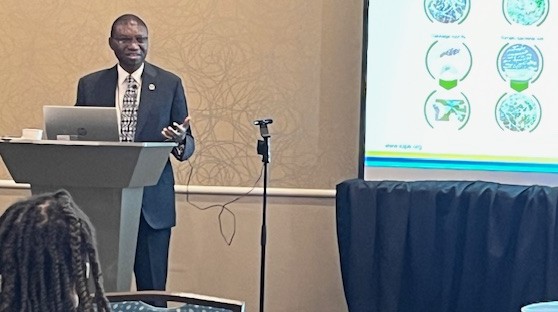
Dr. Sunday Ekesi, deputy director general at the International Center of Insect Physiology and Ecology, Kenya/CEGFSD Advisory Council member, gives his keynote address.
The CEIED summit featured Dr. Sunday Ekesi, deputy director general at the International Center of Insect Physiology and Ecology (ICIPE), as keynote speaker. His address was titled, “Rethinking Global Food Security Challenges – Collaborative Research and Partnership Opportunities for U.S. and African Universities.”
Ekesi discussed global development challenges impacting agriculture and agri-food systems, scientific innovations for impactful solutions as well as the significance of international partnerships.
Ekesi concluded his remarks as follows:
- “The sustainability of agriculture and agri-food systems depends on how soon we humans realize that agriculture takes place in the environment and that a destroyed environment does not work for agriculture — Human footprint on nature (the Anthropocene). So let us not eat away our future.”
- “We stand better chances at effecting positive changes if we boost the resilience of (local residents as) agents of the change they need and aspire to — with disruptive technologies that do not disrupt the environment. Hence, food is a way of life, not just a means for living.”
- “Convergent interventions to develop transformative technologies and innovations through capacity building are needed to tackle convergent disruptors. So collaboration and partnerships between U.S. and African universities and institutions are needed.”
Students’ perspective
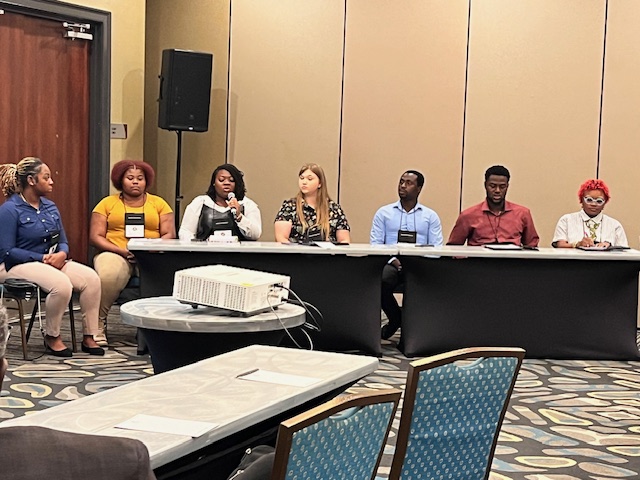
Student panelist/presenters, from left, are Miniya Miller, Fort Valley State University; Antyana Cowan, Kentucky State University; Maia Payne, Tennessee State University; Hannah Knuckles, University of Arkansas Pine Bluff; Erasmus Kabu Aduteye, University of Maryland Eastern Shore; Nicolas Amoah, North Carolina A&T State University; Havilland Ford, University of Arkansas Pine Bluff. Not pictured is Elizabeth Acquah, North Carolina A&T State University.
The CEIED summit featured students’ involvement with the Center during the summit plenary session led by the Center’s Advisory Council member, Dr. Julie Shortridge.
Increasing the supply of a globally trained workforce in Food, Agriculture, Natural Resources and Human Sciences (FANH) across the 1890 universities being one of the Center’s broad goals, students actively participated in the summit through the presentation of their international experiential learning activities, the summit’s problem-solving showcases and the identification of the pillars of a dynamic action plan for the Center.
Among students’ recommendations for the Center’s path forward were issues related to the duration of funds allocated to its operations, new course development and students’ incentivization to participate in international education activities.
According to student feedback, international programs funded for a longer period (at least three years) would adequately improve workforce development. These include internships, student academies on global issues, post-doc research, etc. In addition, students recommended the development of new curricula — such as certificates in global security, international agriculture, etc. — and enhancing existing curricula by infusing global dimensions and integrating teaching, research and extension.
Most 1890 university students would forgo summer jobs to participate in long-term international internships provided they receive a stipend as a motivation for full participation in these global workforce training opportunities.
Key elements of CEIED impact assessment
According to the evaluator, the benefits derived from the current CEGFSD and the initial CEIED are as follows.
The CEGFSD has gained significant insights into potential strategies required to maximize its impact via a two-step process:
- Step 1: Identifying the transformative opportunity for effective globalization impacts through lessons learned and codified as products of the evaluative process. These represent the essential ingredients for success in CEGFSD’s efforts to transform global food security and defense using strategic partnerships.
- Step 2: Build opportunity structures as success- enhancing systems that more fully leverage expertise across 1890 land-grant universities to foster international partnerships that address the CEIED recommendations and proposed actions related to structure and content dimensions.
The CEIED evaluation, however, as a structured, empirical analysis of the project performance/ effectiveness to inform Center decision-making has provided:
- Lessons learned comprehensively span multiple domains and dimensions for the design of the intervention to model development and dissemination.
- Recommendations and potential actions as strategies to enhance the Center’s structure and content dimensions.
- PIs’ output ratings of the overall extent to which the implemented activities attained the project’s desired outputs on a scale of 1-5, where 1=not at all and 5=a great deal. Education’s average rating was 4.5 (a moderate amount); Research’s was 4.9 (a great deal).
- PIs’ outcomes ratings of the extent to which the implemented activities attained the project’s desired outcomes on a scale of 1-5, where 1=not at all and 5=a great deal. Education’s average rating was 4.8 (moderate); Research’s rating was 4.1 (moderate).
- Sustainability plans signal interest in continuing work in global food security, for which recommendations and potential actions were offered.
- Students encapsulating comments indicated, “This project helped to sensitize students and faculty about opportunities in FANRHS nationally and internationally and created training opportunities to position students to be competitive for career path entry in these areas.” Finally, “thank you for the wonderful job you are doing to support projects such as this. We are grateful.”
- Global partners who reportedly benefitted from and contributed to the initial engagement/involvement among the collaborative team. Notably, there is the potential to build on and leverage the opportunities for future and distinctly 1890 Global Food capacity- building initiatives in this global community.
