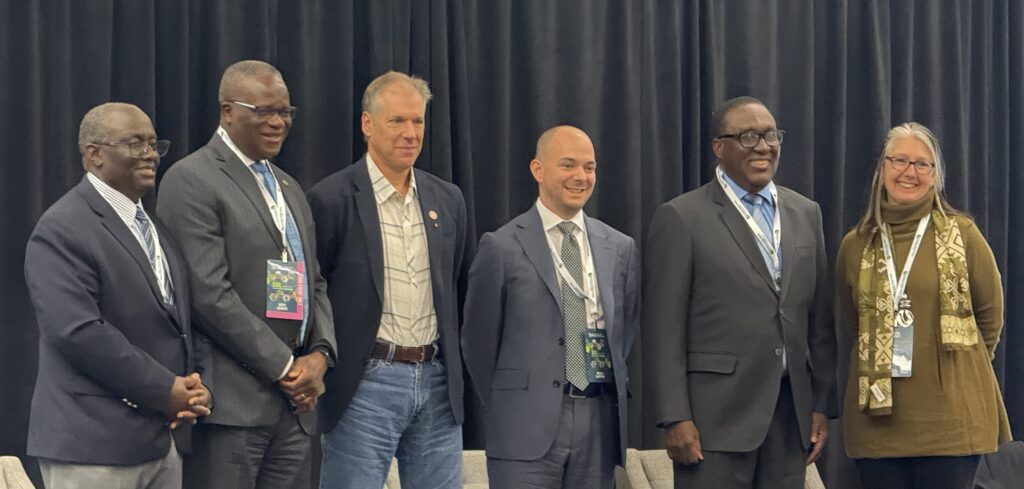
For the second time, the CEGFSD organized the World Food Prize Side Event on Oct. 23, 2025, in Des Moines, Iowa.
Under the theme “Collaborative partnerships and innovation for global food security, an 1890 land-grant perspective,” the side event aimed to synergize the collective capacity across nineteen 1890 land-grant universities to address critical issues of global stability while developing an FAHN workforce of the future.
The CEGFSD is keen to engage other players in this space and establish/grow collaborative partnerships to address these issues. This event provided an exceptional opportunity for the Center to engage key players in this space. All 19 university partners were represented.
The session identified and discussed the most critical food security and global stability challenges in the context of teaching, research and extension, where the 1890 universities, through the CEGFSD, and their partners can make a substantial contribution.
Participants also discussed the imperatives for successful engagement and articulated context-driven solutions that reflect local needs and global priorities in specific short and medium-term actionable goals.
Below is a sample of specific questions posed at this event:
- Identify and discuss the most critical global food and nutritional security challenges where the 1890 land-grant universities, through the CEGFSD and their partners, could bring value and make a substantial contribution in the context of teaching, research and extension.
- How is the role of land-grant universities working in the international development space evolving to meet global challenges and the priorities and imperatives of the new administration? What are the challenges and opportunities.
- Funding is critical for the implementation of international activities, given the changed funding landscape from a U.S. perspective. How can land-grant universities leverage resources to work with international partners to address global food security challenges?
- Given the many players/stakeholders in the global food and nutritional security space, how can synergies be built or enhanced for maximum efficiency and effectiveness in the use of resources?
- Given the increased capacity of national and international partners working in this space, in what ways can U.S. universities bring value and support efforts of such partners?
- Do you have any recommendations on how 1890 land-grant university scientists could establish more effective (resources-wise) collaborative partnerships in the current era of scarce and dwindling resources?
Participants were provided with knowledge and understanding of the priority areas of interest and capacity within these universities to carry out food security and global stability work. Participants also established linkages with 1890 land-grant university scientists leading to the establishment of enduring collaborative partnerships.
The invited speakers for the side event were Marcus Glassman, director of Governmental Affairs for Agriculture and International Development, Association of Public and Land-Grant Universities (APLU); Dr. Koffi Akakpo, Kentucky State University president; Sylvia Megret, ACDI/VOCA board member; Dr. Daniel Kammen, Bloomberg distinguished professor, Johns Hopkins University; and Dr. Simeon Ehui, International Institute of Tropical Agriculture (IITA) director general. Dr. Moses T. Kairo, School of Agricultural and Natural Sciences dean and CEGFSD director at UMES, moderated the session.
Fifth Annual Advisory Council Meeting
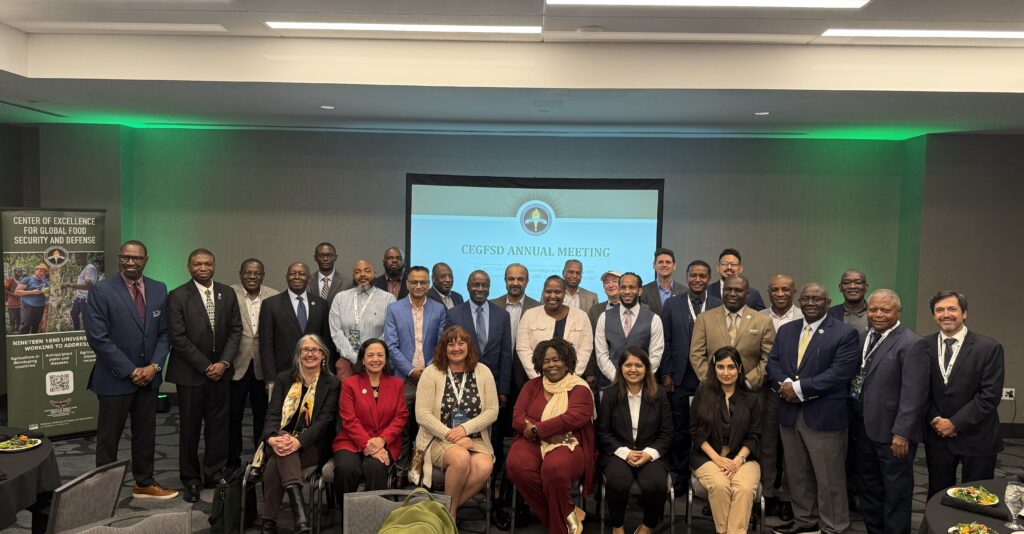
The CEGFSD also held its fifth annual Advisory Council (AC) meeting at the World Food Prize venue on Oct. 20, 2025, centered on “Refocusing the Center and Rethinking Partnerships: New Strategies for the Center’s Future.”
The annual meeting’s opening remarks were made by Kairo followed by Dr. Stephan Tubene, CEGFSD associate director, who highlighted the Center’s Impacts.
These two presentations came before presentations on the Center’s showcase activities conducted by its project directors (including Drs. Lamin Drammeh, Ayesha Sarker, Ryszard Puchala and Simon Zebelo) highlighting the Center’s work in the Gambia, Costa Rica, Jamaica and Kenya, respectively.
In addition, Dr. Antonio McLaren, vice president for Program Innovation and Implementation, introduced the 1890 Universities Foundation’s work in advancing the 19-Strong Initiative.
Led by AC President Megret, the AC welcomed its new members (including Kammen and Dr. James Oehmke, professor and department chair, Rutgers University). The AC also welcomed Dr. Felicia Nave, the newly appointed 1890 Universities Foundation president and CEO, to the annual AC meeting.
Changes by Executive Order
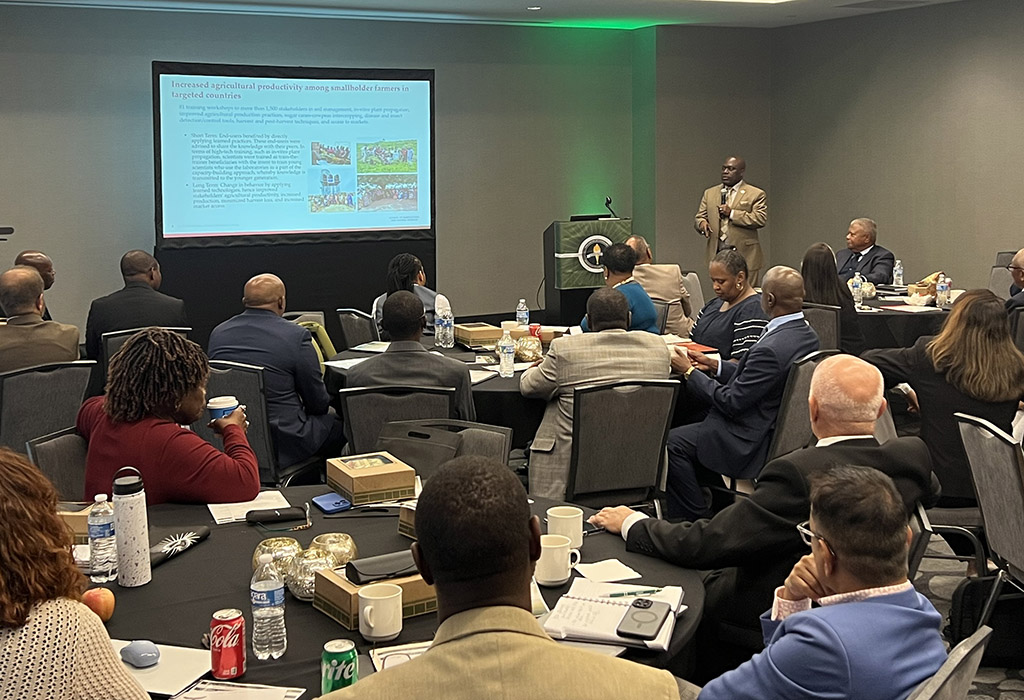
In his opening remarks, Kairo’s presentation, titled “Refocusing the Center at a Time of Change,” outlined the Trump administration’s executive orders and USDA Secretary Memorandums, as well as the Center’s future direction and priorities.
The executive orders triggered changes in the Center’s goals and priorities. Established in 2020, the Center of Excellence for Global Food Security and Defense (CEGFSD) leverages the collective capacity of all nineteen 1890 land-grant universities across 18 states to carry out work that supports the U.S. domestic policy priorities.
This includes boosting U.S. agricultural trade, improving economic growth and prosperity of rural communities through increased agricultural exports and expansion of rural employment, while fulfilling the nation’s needs for a globally competent workforce.
The Center is hosted at the University of Maryland Eastern Shore and serves all nineteen 1890 land-grant institutions. It is one of six Centers of Excellence (COEs) at 1890 universities identified in the 2018 Farm Bill. The Center is supported with funds from the U.S. Department of Agriculture’s National Institute of Food and Agriculture (NIFA).
The Center’s work not only reinforces domestic economic growth but supports national security by building strong food systems and securing America’s leadership in global agriculture through education, research and outreach.
The Center supports projects that address four broad goals:
- Strengthening U.S. agricultural prosperity.
- Addressing new and emerging animal and plant pests and diseases.
- Building strong food systems.
- Fulfilling the nation’s needs for a globally competent workforce.
This is accomplished through the five interlinked priorities:
- Improvement of agricultural productivity.
- Enhancement of global food supply chains.
- Improvement of food safety.
- Emerging technologies.
- Impacts of trade on food availability, access, use, and stability.
The AC meeting concluded with actionable steps, including organizing a workshop to develop a strategic plan that will guide the Center’s future, taking into consideration the new Center’s mandate, reaching out to the other COEs for concerted effort, and seeking alternative resources from the private sector and the global south to support the Center’s activities.
