
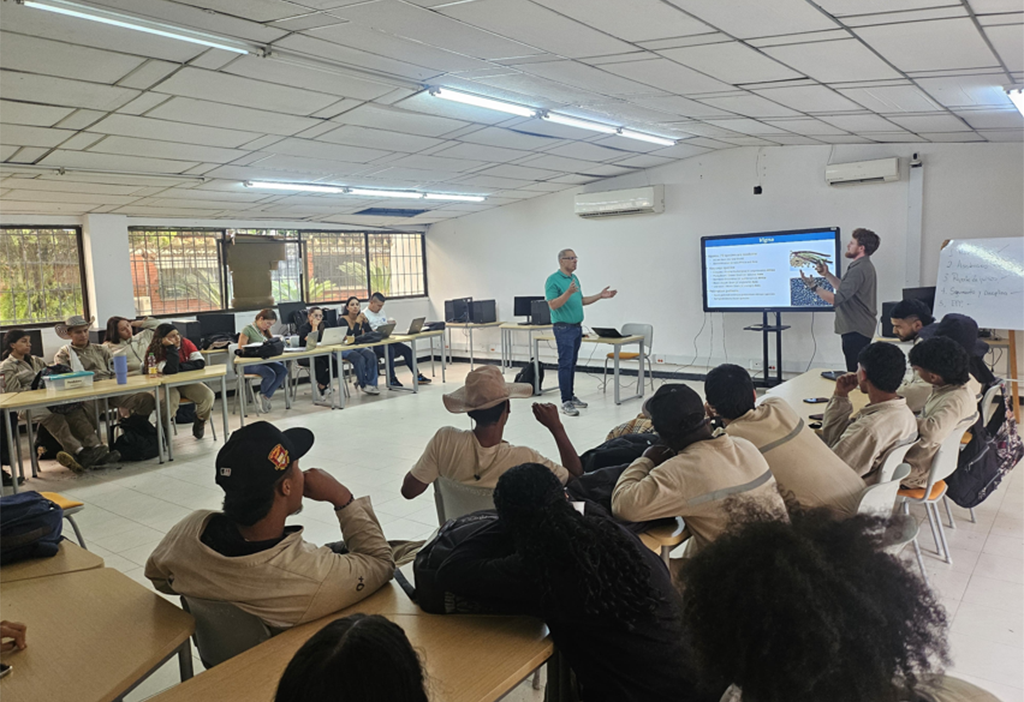
As part of efforts to strengthen agricultural development abroad and in America, Ph.D. student Josh Relyea traveled to Colombia for a partner visit with Servicio Nacional de Aprendizaje (SENA, National Learning Service) from April 12-19, 2026.
His advisor, Dr. Matthew Blair, is the PI for the project titled, “Building on Cowpeas for Colombia: Legume Systems for Nutritional Security and Monitoring Emerging Pathogens for Food Security and Defense.”
The trip was centered on gaining experience in agricultural sector topics, including multiple sub-tropical and tropical crops in a set of SENA locations, as well as transmitting information about Tennessee State University (TSU) research on the grain legumes to a Colombian audience.
The purpose of the trip was to observe how SENA is expanding its role in agricultural education, applied research, technical training, facility development and community outreach.
The trip also aimed to provide a window for SENA faculty and students on how TSU has advanced its research portfolio of grain legumes beyond the common bean. For example, the initial grain legume that TSU has worked on is cowpea, a favorite element of the cuisine and agricultural production of Southern states from Tennessee to Florida and Texas.
SENA has worked with TSU to develop a new set of cowpea varieties in various seed colors for the mid-altitude valleys of the Andean region, under two CEGFSD projects.
The second grain legume TSU has conducted research under the CEGFSD-funded project is the mung bean. Originally from Asia, mung bean is currently not widely grown in America.
Relyea is conducting his Ph.D. research on the physiological adaptation of this crop species to the southeastern United States. Mung bean has wide potential across the Southern and Midwestern states, with partnerships and seed exchange between TSU and universities in Iowa, Oklahoma, South Carolina and Virginia.
Yet neither cowpea nor mung bean is well known in Colombia. Still, both could be popular pulse legumes for importation from the United States and for food security in the rest of Latin America. Cowpea is a major crop in Venezuela and spills over into coastal regions, but mung bean is only produced in a small region of Peru.
The trip included a presentation by Relyea on grain legume productivity with professors and students from SENA attending, followed by presentations by their staff on new entomology innovations, electric motors and potential in agricultural equipment, as well as practicing renewable strategies for coffee bean packaging.
The presentations introduced current research activities and future goals for SENA’s agricultural programs. These reports showed how SENA is connecting crop protection, optimal mechanization, technology and hands-on instruction to prepare students and producers for modern agricultural systems.
The trip included visits to farms and community-based projects that collaborate with SENA, including Ecogranja Urbana El Colibrí and Jóvenes Cultivando Futuro.
At the latter, Relyea observed the full horticultural production process useful for vegetables and legumes, from seedling germination to plant care, packaging, transportation, sale and final consumption.
Overall, the Colombia trip showed Relyea how SENA has built a practical agricultural education and research system connecting students, producers, farms, schools and communities. It updated the SENA partners on the TSU work for grain legumes, which is important for food security in the United States and Latin America.
Regarding future collaboration, SENA continues to support innovation by introducing and evaluating new crops (such as cowpeas and mung beans) with advice from TSU within its agricultural programs.
