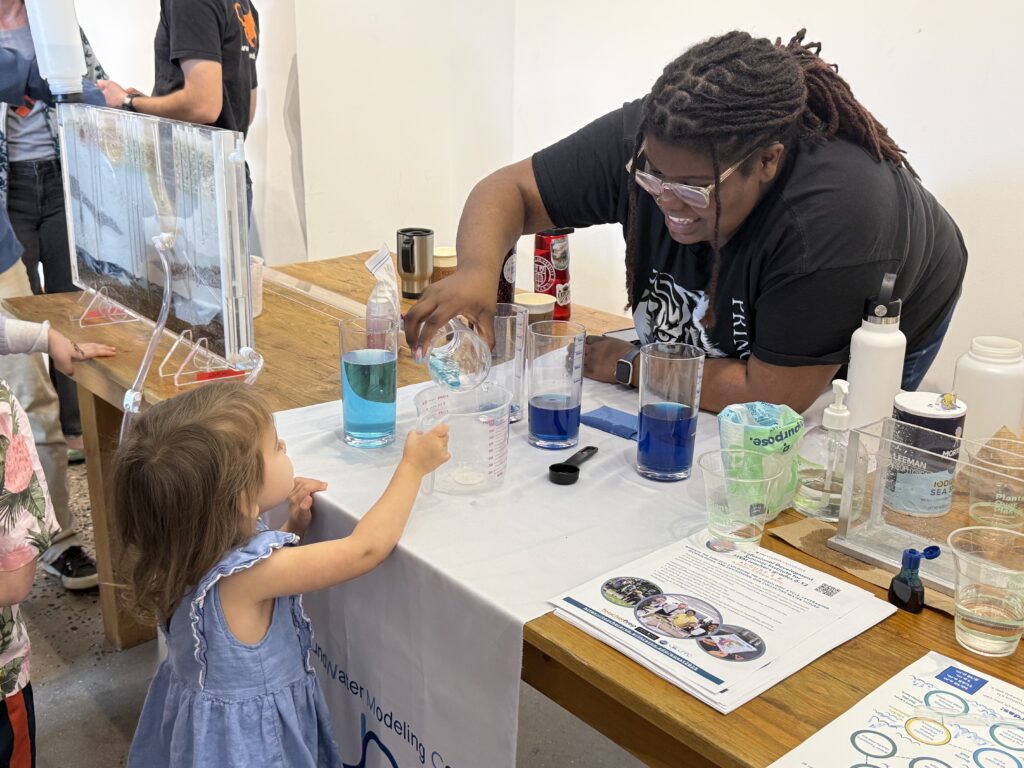
UMES Class of 2024 alumna Jasmine Pinchinat used her participation in a Chesapeake Bay collaborative research project and two subsequent summer internships as a springboard into a coveted full-time position at Princeton University. She is now working for the New Jersey Ivy League school as a community organizer in its Integrated GroundWater Modeling Center, Department of Civil and Environmental Engineering.
Pinchinat got the leg up as an undergraduate pursuing an environmental science degree with a marine biology concentration in UMES’ School of Agricultural and Natural Sciences. She worked on the project exploring how groundwater and surface water interact to shape conditions in the Chesapeake Bay with UMES professor of physical oceanography Meng Xia and Princeton professor of civil and environmental engineering Reed Maxwell.
The Princeton side of the research team created computer models to track groundwater movement, particularly during heavy rainfall events like Hurricane Ida in 2021, while the UMES side studied how these events impact water temperature and salinity in the Chesapeake Bay. In the past, these presented a puzzle for bay-area residents to solve, Xia said.
“Jasmine was a valuable member of the research team. She collected oceanographic and hydrologic data related to compound flooding, which was later used to help design computer simulation,” Xia said.
The life-changing connection to the project and her work with Princeton happened by chance, Pinchinat said.
“Dr. Xia mentioned the research opportunity almost in passing at the end of an oceanography class, and I took a leap of faith. What began as a short, exciting and slightly nerve-wracking first internship at Princeton become something much more meaningful,” she said.
Pinchinat was invited back to the Integrated GroundWater Modeling Center for a full summer internship after graduating from UMES.
“The experience allowed me to see what was possible and from there everything seemed to fall into place. It shaped the direction of my career in ways I couldn’t have anticipated. Being able to teach high school students while deepening my understanding of science communication felt like finally stepping onto a path where I could truly see myself, one that aligned with the career I had always dreamed of,” she said.
PACRI was a transformative stepping stone, she added, from presenting at the American Geophysical Union to growing as a professional.
Findings were presented at the Ocean Sciences meeting in New Orleans and the Asia Oceania Geosciences Society annual meeting in Singapore, among others. Their research showed extreme weather can rapidly change the Chesapeake Bay’s salinity and water structure.
“This study will become one of the influential numerical modeling work for the groundwater-surface water interaction in the estuaries and coastal ocean,” Xia said.
The work was supported primarily through the Princeton Alliance for Collaborative Research and Innovation, a partnership among five historically Black colleges and universities, including UMES was one. The program’s goal was to allow for research between Princeton faculty and their HBCU counterparts. PACRI commenced in March 2022 and concluded May 2026, having funded 20 joint team projects.
“Jasmine’s success is a powerful example of what happens when talented UMES students are given meaningful access to high-level research, strong faculty mentorship and transformative external partnerships,” said Dr. Vagner Benedito, SANS associate dean for research. “This is exactly the kind of outcome we want to see from collaborative programs such as PACRI: students gaining confidence, building professional networks and using research as a pathway to impactful careers. We are very proud of Jasmine, Dr. Xia and the broader research team for showing how SANS scholarship can open doors well beyond our campus.”
Gail Stephens, agricultural communications, University of Maryland Eastern Shore, School of Agricultural and Natural Sciences, UMES Extension, gcstephens@umes.edu, 410-621-3850.
Photos submitted.
