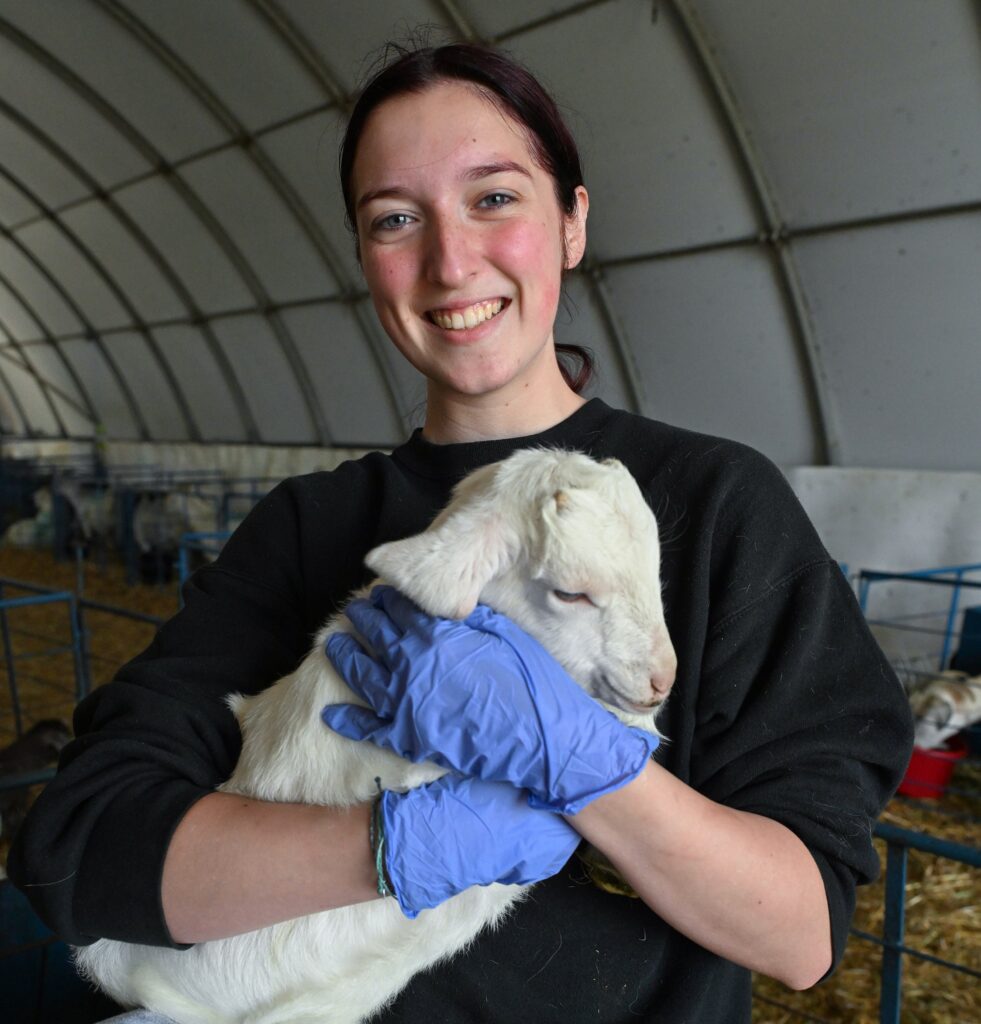
Lambing and kidding season looks a little different on a college campus compared to a small farm. It takes a total team effort to monitor and care for expecting ewes and does through the delivery of their offspring and post-partum period. It’s one that demonstrates the connectivity of the university, the School of Agricultural and Natural Sciences and UMES Extension.
In a span of roughly two weeks, 29 lambs and 52 kids were born this season in dedicated birthing barns tucked away from the the university’s main academic areas. The births timed closely together is the result of an estrus synchronization practice UMES Extension validated and has followed for the past decade.
“The system facilitates feeding, vaccination, ear-tagging, wethering and other post-birth activities for the newborns,” said Dr. Enrique N. Escobar, associate dean for UMES Extension and lead for its Small Ruminant Program.
The condensed timeframe is a bustling one full of challenges and triumphs.
The expecting mothers receive prenatal care, which is supervised by Escobar and UMES campus veterinarian Dr. Kimberly Braxton. About a month before estimated lambing and kidding, the animals are moved in from the pasture and are watched around the clock by UMES Extension veterinary assistants and student interns. When they start giving birth, extra help from campus arrives.
Student volunteers from the School of Agricultural and Natural Sciences pre-vet program, other majors within the school and even volunteers from the university’s athletic teams pitch in.
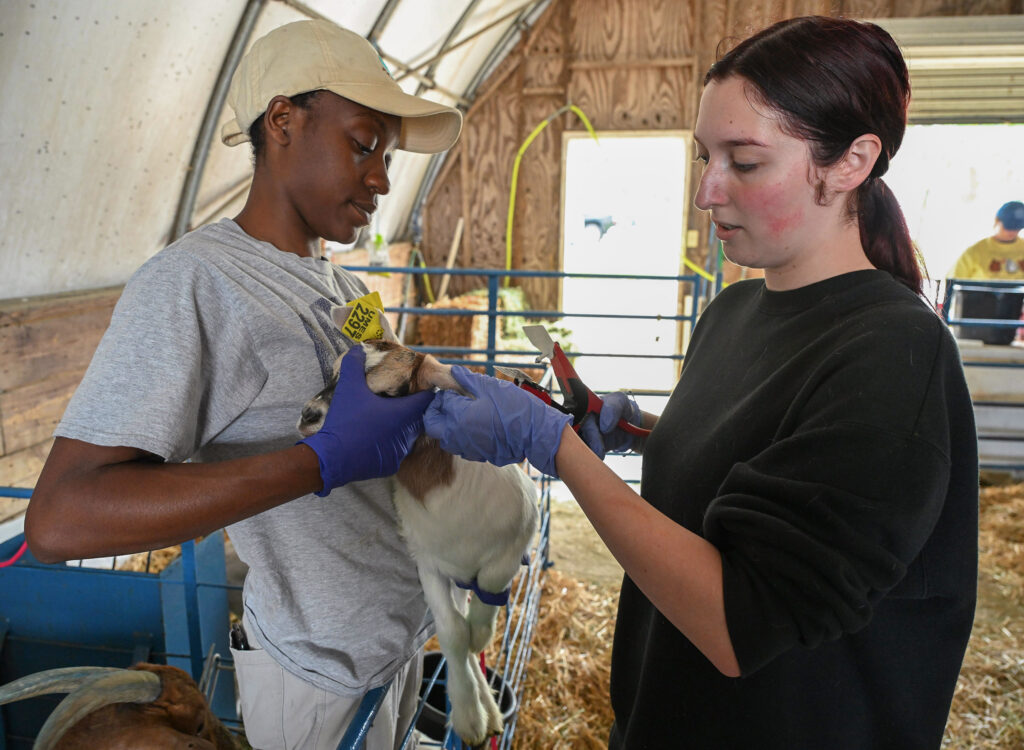
“They are an asset, helping freshen food and water for the mothers (dams) and filling bottle feeding slots for the lambs and kids that need the extra care. It’s hands-on 24-7 until all the babies are safely born,” said Shamia Onley, a veterinary assistant and UMES pre-vet alumna.
For Kathleen Combs, a freshman pre-vet student, it provided a glimpse into the future.
“I got a lot of hands-on experience that helped me see that it’s truly what I want to do,” she said.
Her aha moment was when she assisted one of the goats during labor.
“I monitored the kid’s breathing and made sure it was warm through the night. It was a 32-degree night, and we had to use heat lamps.”
Combs lives on her family’s farm in St. Mary’s County, Maryland, but someone else farms the row crops grown there. As for animals, she said, she has only been around her pet cats and dogs and fosters.
On the other end of the spectrum, Kaitlyn Cosgrove, came to UMES with lambing and kidding experience on her family’s farm in Calvert County, Maryland. Like Combs, this is her first year at UMES, but the junior transferred from the College of Southern Maryland.
“One of the reasons I came here was for the pre-vet program and the hands-on experiences. I appreciate working with a professor, Dr. Kimberly Braxton, and am working toward applying to vet school,” she said.
“Growing up on a farm, it feels like home and it’s not too far away,” the aspiring veterinarian said.
She also wants to focus on livestock and be the next generation to run the family farm.

Gabrielle “Gabby” Henderson came to the university from the suburbs of Waldorf, Maryland.
“I wasn’t used to the farm and trees all around, but my mom was from a farm in Alabama. It was different for me, but I love being here and the farm experience,” said the junior pre-vet student.
“The more I come, the flies don’t even bother me,” she joked, referring to the inevitable pests even though the barn is kept with a rotating fresh supply of clean straw.
Henderson is leaning toward veterinary radiology.
“Working with the animals, it’s a great experience. I feel like I learned a lot more than what you get from a lecture alone. It’s also more beneficial to help prep for vet school,” she said.
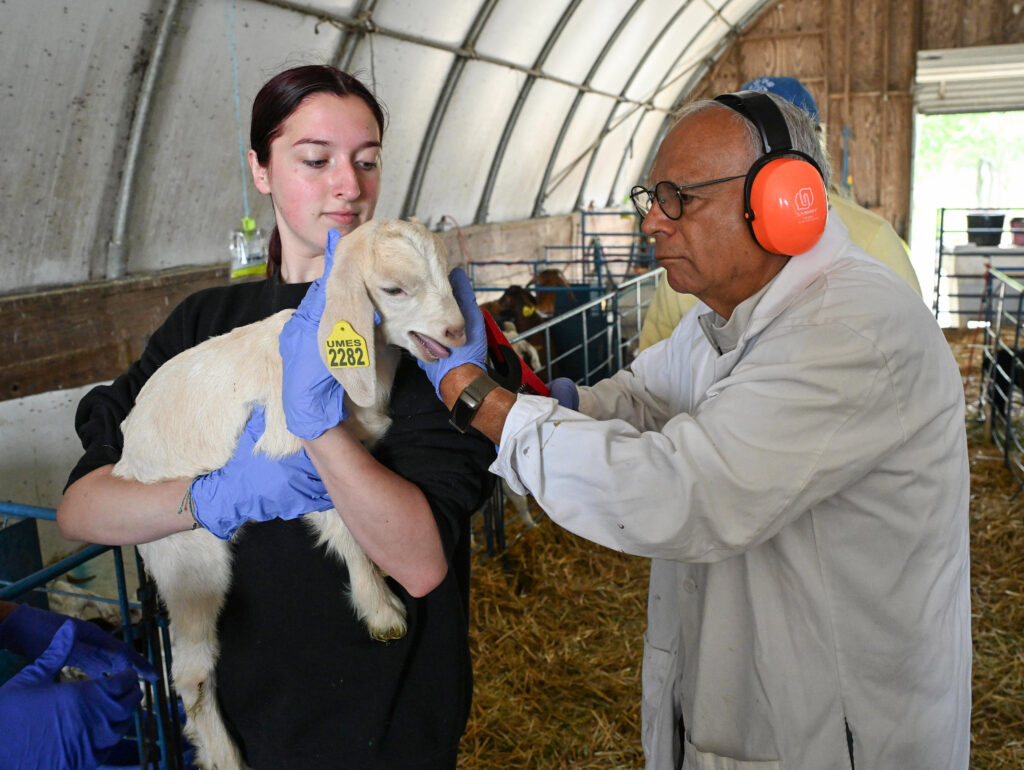
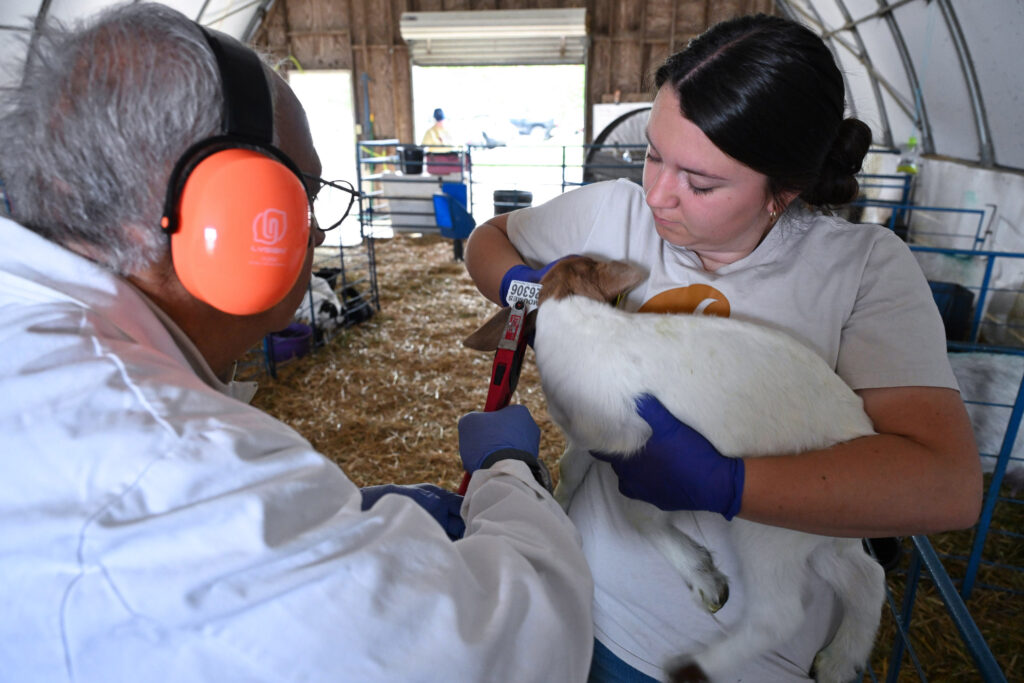
A favorite baby goat she was holding was next up to receive its ear tags, right ear for female and left for male, and the opposite ear with its U.S. Department of Agriculture Scrapie Eradication Program tag. Sheep and goats require official identification and traceability tags.
“Two in a row, you got this,” she said as it let out a high-pitched squeal comparable to a human baby getting an inoculation.
“What a drama queen,” Escobar commented with his headphones over his ears.
The student caretakers are happy regaling visitors with the personalities of the does and dams, particularly their offspring. Once named, it sticks. This season, there’s Hercules, Hera, Fiona, Cannoli, Noodle and Trifecta, among others.
Not only do the goats on campus receive a lot of cuddling but maybe also an advanced education.
“Look, these two are ruminating. That’s amazing at just over 3 weeks old,” Escobar said as he watched their throats as they swallowed some hay and brought it back up to their mouths to rechew the cud; the reason the animals are called ruminants.
“The sooner they ruminate, the better for less dependency on the mother for feeding and on us,” he said. “It usually starts at 4-6 weeks, so I guess these are educated kids.”
Gail Stephens, agricultural communications, University of Maryland Eastern Shore, School of Agricultural and Natural Sciences, UMES Extension, gcstephens@umes.edu, 410-621-3850.
Photos by Todd Dudek, agricultural communications, University of Maryland Eastern Shore, School of Agricultural and Natural Sciences, UMES Extension, tdudek@umes.edu.