School of Veterinary Medicine at UMES
The University of Maryland Eastern Shore (UMES) is establishing a new School of Veterinary Medicine (SVM) to address critical needs in veterinary medical education, animal health, and public health. This initiative is dedicated to providing high-quality veterinary training, advancing research, and serving communities – particularly those in underserved and rural areas. The UMES SVM will enhance diversity within the veterinary profession and build a world-class educational program that serves as a hub for veterinary innovation, research and community outreach – not just for Maryland but the the entire region and beyond.
We are excited to share updates on the school’s opening on this page.
About the School of Veterinary Medicine at UMES
Our new School of Veterinary Medicine at the University of Maryland Eastern Shore is currently seeking accreditation through the American Veterinary Medical Association (AVMA) Council on Education (COE) and will be the first of its kind in Maryland and among the nation’s public historically Black colleges and universities.
Pending approval from our accrediting body, the SVM will begin admitting students and will build upon UMES’ strong legacy as a 1890 Land Grant HBCU. The new school complements the University’s nationally recognized programs in agriculture, agribusiness, natural sciences, and health professions – adding another distinguished offering to an institution that already provides more health professional programs than any other HBCU in the country.
The Doctor of Veterinary Medicine (DVM) program aims to meet the growing demand for veterinarians both regionally and nationally, while advancing diversity within the profession. The establishment of the SVM further strengthens UMES’ role as one of nineteen 1890 Land-Grant institutions committed to excellence in education, research, and service.
Latest News
- Media Clippings: ‘We want to help’: Where pet owners can find affordable care after vet closures
 By Taylor Epps, WMAR-TV, Baltimore, May 29, 2026 The announcement that a longtime East Baltimore animal hospital was planning to close is shining a light on a growing veterinarian shortage affecting communities across Maryland…Read more Media Clippings: ‘We want to help’: Where pet owners can find affordable care after vet closures
 - Getting to know Dr. Christina Dougherty, UMES SVM’s Associate Dean for Clinical Programs and Outreach
 Dr. Christina “Tina” Dougherty, who is the University of Maryland Eastern Shore School of Veterinary Medicine’s (UMES SVM) new Associate Dean for Clinical Programs and Outreach, always had a soft spot for…Read more Getting to know Dr. Christina Dougherty, UMES SVM’s Associate Dean for Clinical Programs and Outreach
 - Media Clippings: UMES vet school: Where does accreditation stand?
 By Demetrius Dillard, Maryland Daily Record, April 24, 2026 In its quest to make history in the state and among public historically Black colleges and universities, the University of Maryland, Eastern Shore‘s planned school…Read more Media Clippings: UMES vet school: Where does accreditation stand?
 - Dougherty Joins UMES School of Veterinary Medicine as Associate Dean for Clinical Programs and Outreach
 University of Maryland Eastern Shore’s School of Veterinary Medicine (UMES SVM) has announced the appointment of Dr. Christina ‘Tina’ Dougherty as Associate Dean for Clinical Programs and Outreach. Dougherty began her new…Read more Dougherty Joins UMES School of Veterinary Medicine as Associate Dean for Clinical Programs and Outreach
 - UMES School of Veterinary Medicine Names New Associate Dean for Research and Innovation
 The University of Maryland Eastern Shore School of Veterinary Medicine (UMES SVM) is proud to announce the appointment of Dr. Reginald Miller as its new Associate Dean for Research and Innovation. Dr….Read more UMES School of Veterinary Medicine Names New Associate Dean for Research and Innovation
Key Points about the School of Veterinary Medicine at UMES
- Innovative Veterinary Education: UMES SVM will offer a comprehensive Doctor of Veterinary Medicine (DVM) program designed to produce competent, day-one ready veterinarians skilled in caring for companion and large animals across diverse communities. The curriculum emphasizes biological knowledge, clinical skills, emergency response, and evidence-based medicine.
- Research and One Health Focus: The school will drive research at the intersection of veterinary science, public health, and agricultural sustainability, addressing zoonotic diseases, food security, and environmental health through a One Health approach.
- Community Service and Access to Care: UMES SVM plans to offer clinical services, outreach, and extension programs supporting Maryland’s agricultural industries and underserved populations to improve animal and human health.
- Addressing Veterinary Workforce Needs: The program responds to a national and state shortage of veterinarians, with projected employment growth of 19% nationally and 13% in Maryland by 2031. It will serve as Maryland’s first stand-alone veterinary school.
- Promoting Diversity in Veterinary Medicine: As the first public HBCU veterinary school, UMES SVM aims to increase representation of Black Americans and other people of color in a profession currently dominated by white Americans.
- Complementary Academic Programs: The DVM program will support related degrees, including a B.S. in Veterinary Technology and graduate programs in biomedical sciences, addressing growing national demand for these fields.
- Clinical Training and Partnerships: The school will employ a dynamic, accelerated three-year program with a semi-distributed clinical model, partnering with private, public, and corporate entities to provide diverse clinical experiences without requiring an on-campus teaching hospital.
- Infrastructure and Facilities: UMES plans to construct a new 60,000-square-foot building housing clinical skills labs, classrooms, and research spaces, alongside renovated existing facilities and a new veterinary barn for large animal training.
- Economic and Public Health Impact: The school will support Maryland’s agricultural economy by training veterinarians skilled in large animal medicine, contribute to research on food safety and zoonotic diseases, and enhance public health through its One Health initiatives.
Frequently Asked Questions
When will the UMES veterinary school open? When can I join the school?
- UMES SVM plans to admit its inaugural class following approval from our accrediting body, with a target date of summer 2027.
Why is the UMES School of Veterinary Medicine significant?
- This will be the first public HBCU to have a veterinary school.
- This will be Maryland’s first stand-alone veterinary school. There are no other schools in Delaware or Washington D.C areas.
What’s different about the UMES vet school?
- Our proposed DVM program is a three-year accelerated program, with year-round attendance.
- The proposed target is to graduate 100 students per year.
- Our clinical training program is a semi-distributed workplace-based program, where students will do their clinical training in various private, public, and corporate practices.
Who can I contact for more information?
- Email: vetschool@umes.edu
- Call: 410-651-7140
Is the SVM accredited?
- Both the Maryland Higher Education Commission (in January 2024) and the University System of Maryland Board of Regents (in December 2023) approved the creation of a UMES School of Veterinary Medicine.
- The DVM program is going through the accreditation process by the American Veterinary Medical Association (AVMA) Council on Education (COE). UMES initiated the accreditation process in May 2023 by writing to the COE requesting a consultative site visit, which was conducted in July 2024. A comprehensive site visit request has also been granted with a visit expected to be scheduled for summer 2026. The timing of the specific key follow-up actions will become more known in due course.
What is the timeline on the school’s opening?
- The university is making advances in advocacy, fundraising and infrastructural developments, in anticipation of students for summer 2027, pending approval from our accrediting body (COE).
Why is a vet school needed?
- The UMES School of Veterinary Medicine will help fill an unmet need for veterinarians (large animal and small animal pets) throughout the nation, Maryland and the Eastern Shore.
- There will be a 19% projected growth in the field over the next seven years.
- Black veterinarians make up less than 3% of the total population of veterinarians.
Learn more:
- Email: vetschool@umes.edu
- Call: 410-651-7140
CONTACT US
Seeking more information about the UMES School of Veterinary Medicine? Contact us by email at vetschool@umes.edu or by phone at 410-651-7140.
MEDIA INQUIRIES
umesnews@umes.edu
Video
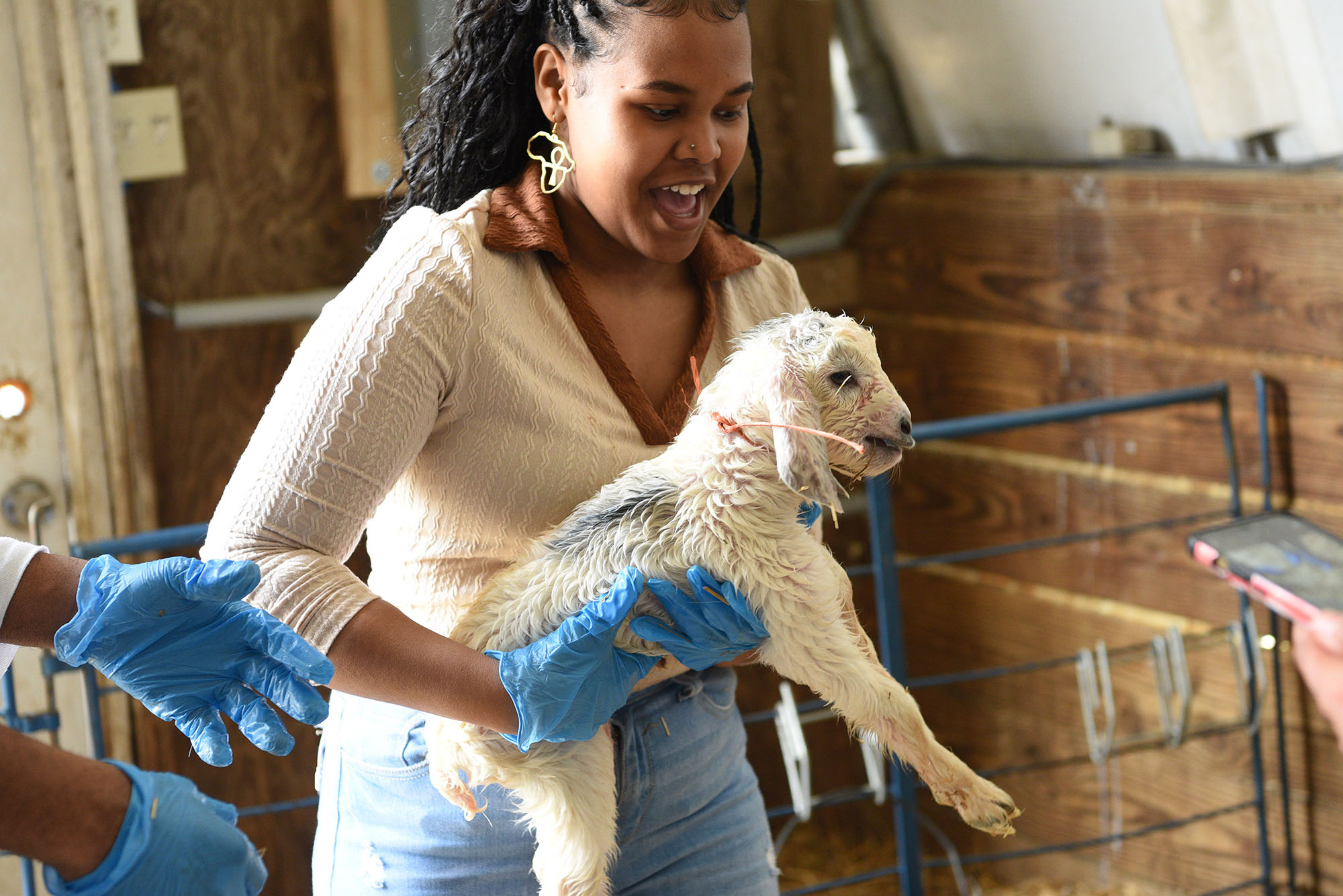
WARNING: The video below shows a live birth at UMES that pre-vet students take part in.
