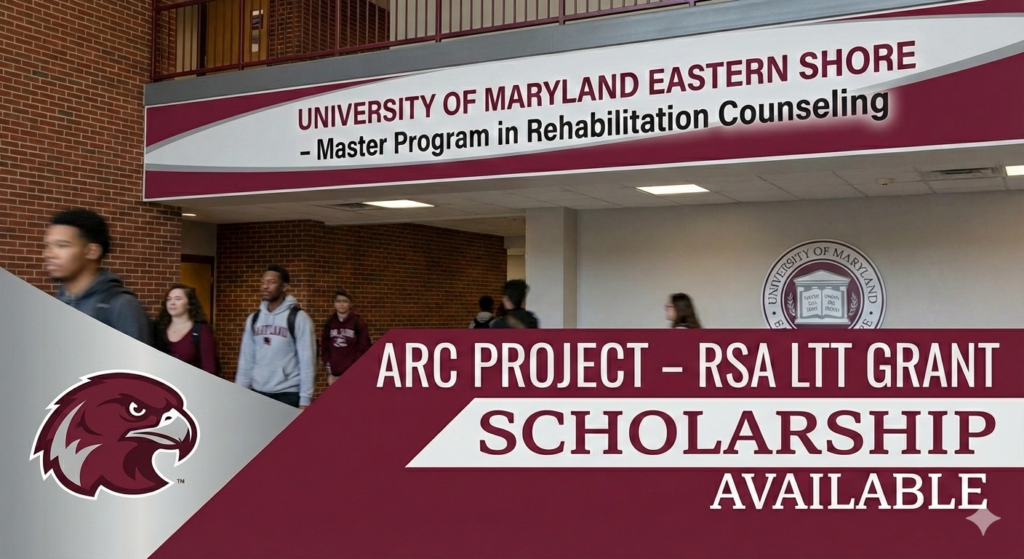
The Master of Science in Rehabilitation Counseling program at UMES is supported by a Long-Term Training grant (H129B210015) awarded by the Rehabilitation Services Administration (RSA), Office of Special Education and Rehabilitative Services, U.S. Department of Education. Funds from this grant are utilized to provide scholarships to eligible graduate students. This financial assistance covers tuition, fees, and stipends to support the training of qualified rehabilitation professionals.
What is the Rehabilitation Services Long Term Training Grant?
This program offers scholarship funding to students in rehabilitation studies. Note that accepting this funding comes with a specific service agreement:
- The Commitment: For every year of funding you receive, you agree to work for two years in the rehabilitation field at a qualifying public or non-profit agency.
- The Alternative: If you do not fulfill the work requirement, you must pay back the financial assistance.
To support your success, the university is dedicated to connecting you with State VR agencies and helping you identify employers that meet these service requirements.
UMES ARC Project
This five-year project, denominated ARC: Advancing Rehabilitation Counseling, seeks to support the academic training of RSA scholars, providing up to ten (10) traineeships annually to qualified graduate students pursuing a Master’s degree in Rehabilitation Counseling. The training provided through this project will result in a graduate degree that meets the requirements outlined in Absolute Priority 2 of the RLTT Program, which supports academic preparation in key rehabilitation topic areas including Vocational Rehabilitation Counseling (ALN 84.129B).
This proposal is grounded in the intent of the U.S. Department of Education and RSA to (i) increase the supply of trained personnel available to State and other public or nonprofit agencies involved in the rehabilitation of individuals with disabilities who are academically and clinically prepared to deliver comprehensive, person-centered, and evidence-based services, and (ii) improve the skills and quality of professional personnel to address the vocational, psychological, medical, and social needs of underserved and underrepresented people with disabilities.

Who is Eligible?
To be considered for this grant, applicants must meet the following requirements across academic status, legal standing, and program commitments.
1. Academic Enrollment & Performance
- Student Status: Be enrolled as a full-time graduate student in the Rehabilitation Counseling (RC) program.
- Academic Standing: Maintain a Grade Point Average (GPA) of 3.0 or above.
- Progress: Maintain satisfactory progress toward completing all degree requirements.
- Compliance: Adhere to all program enrollment, retention policies, and personal-professional disposition policies.
2. Legal & Financial Standing
- Citizenship: Present evidence of United States residency or citizenship status.
- Federal Standing:
- Must not be in default on a debt to the federal government under a non-procurement transaction.
- Must not be declared ineligible to receive federal assistance by a judge under the Anti-Drug Abuse Act of 1988.
- Conflicting Aid: Must not be concurrently receiving any other educational allowance (federal, state, local, or voluntary) if that allowance requires a conflicting employment obligation.
3. Program Commitments & Agreements
- Career Intent: Demonstrate a clear interest in a career in the vocational rehabilitation of individuals with disabilities.
- Fieldwork: Agree to complete a practicum and an internship in an approved Vocational Rehabilitation Agency or a related field within the scope of practice.
- Service Obligation: Agree to the employment payback obligation (working in a qualifying agency or repaying the assistance) as outlined in the program summary.
